
Primira Luxury Blog
“Jewelry is more than an accessory; it’s a timeless tale waiting to be told.”
“Like a well-crafted gem, true beauty comes from within. Let your jewelry amplify it.”


Discover Your Perfect Price
Filter by Stone Type and Metal to view accurate, variation-based pricing
Transparent, personalized, and effortless - explore designs that match your style, metal, and budget.
- Tip: Choose one stone type and one metal type to see your exact price.
- If prices seem off, just uncheck and re-apply your filters – the page will refresh with accurate pricing.
 1-to-1 Custom Design
Experience
 Craft Your Vision
Today with a 10% Starte
 HD video Preview
Before It Ships
 Fully Customizable
- Stone, Metal & Budget
 Choose Metal Tone:
Yellow, White or Rose Gold
 Handcrafted in Solid 10K · 14K · 18K
Gold, 925 Silver or 950 Platinum
 Select Your Stone Type:
 Lab-Grown Diamond or Moissanite
 Award winning
 craftmanship and detailing
 Hallmarked &
 Certified (IGI / SGL)
 Personalized Care &
 Expert Support
 Design Any Piece
Within Your Budget
1-to-1 Custom DesignExperience
Craft Your VisionToday with a 10% Starte
HD video PreviewBefore It Ships
Fully Customizable- Stone, Metal & Budget
Choose Metal Tone:Yellow, White or Rose Gold
Handcrafted in Solid 10K · 14K · 18KGold, 925 Silver or 950 Platinum
Select Your Stone Type: Lab-Grown Diamond or Moissanite
Award winning craftmanship and detailing
Hallmarked & Certified (IGI / SGL)
Personalized Care & Expert Support
Design Any PieceWithin Your Budget
Primira's
Real Reviews From Real Customers
Lifetime
Warranty
100% Money
Back Guarantee
Easy
Customization
7 Days
Return
14 Days
Exchange
Insured
shipping
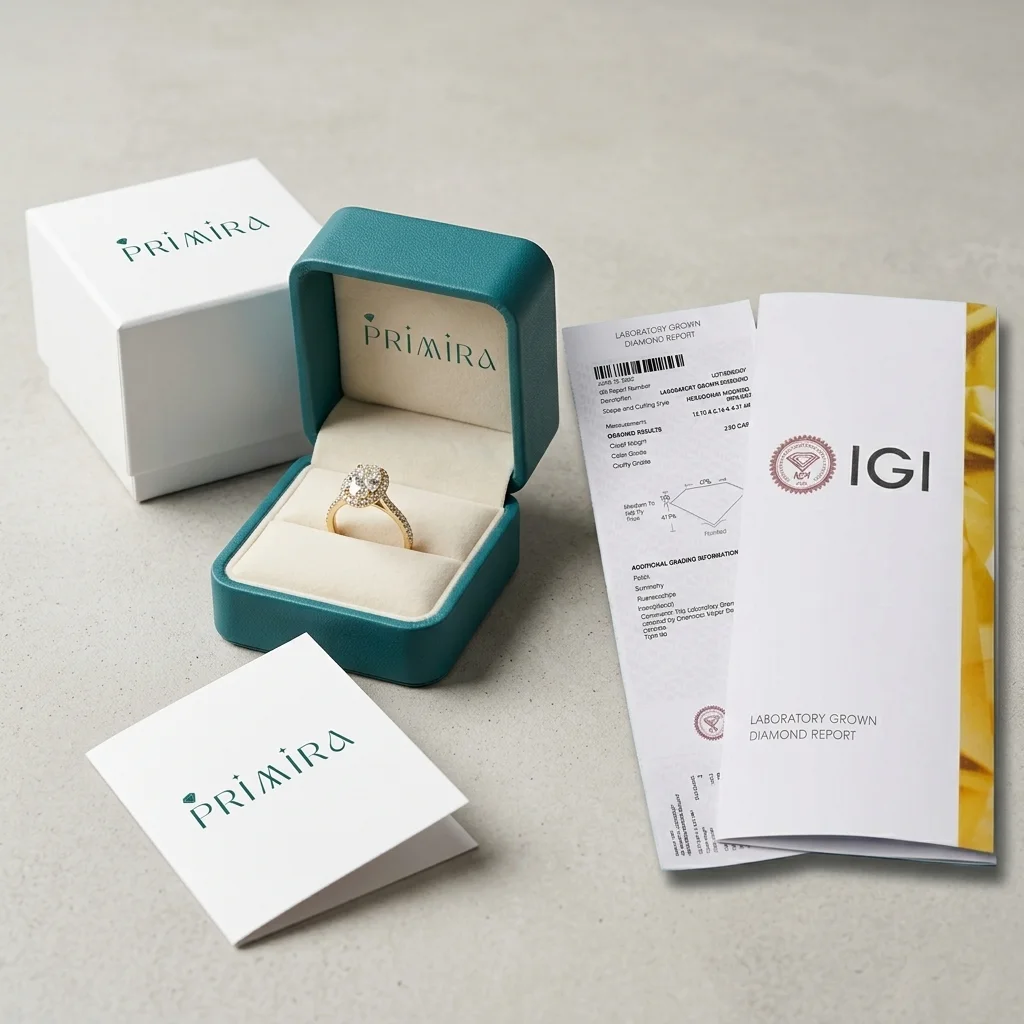
sustainable, beautiful packaging
Give your precious pieces a home they deserve with our stylish, soft-lined jewelry boxes made for effortless organization.
Read Our Article Behind Every Collection
Each design at Primira Luxury is handcrafted with precision, purpose, and emotion. From the first sketch to the final polish, our artisans turn your vision into a piece that feels personal, ethical, and timeless.
Read More
Lab Grown Diamond Tennis Necklace — Buying Guide
A tennis necklace is 100 to 140 individual lab grown diamonds set in a continuous line around the neck. Every single one of them needs to match. That’s the purchase — not which style you like or what length you want. Those decisions come after. The first question is whether the stones in the piece you’re considering actually came from the same source under the same conditions, or were assembled from whatever inventory happened to be close enough.
This distinction matters more for a tennis necklace than for almost any other piece of jewelry. A solitaire ring with one excellent stone stands on its own. A tennis necklace with 120 stones that are 95% matched looks noticeably different from one where every stone genuinely came from the same production run — even when the specifications on paper read identically.
Surat processes 90% of the world’s rough diamonds, and Primira’s CVD and HPHT growth facilities sit inside that district. That means matched-parcel sourcing isn’t a curation exercise done after growth — it’s a production-stage decision, sorting stones by colorimeter before a single one reaches a setting. It’s the difference between stones that were selected to match and stones that were made to match.
What Stone Matching Actually Means
A tennis necklace carries its total carat weight across individual stones that typically range from 0.03ct to 0.20ct each, depending on total carat weight and chain length. At that individual stone size, the 4Cs don’t work the same way they do for a solitaire.
Color
At 0.05–0.15ct individual stone size, color differences between D and G are essentially invisible to the naked eye. The choice that matters is whether every stone in the necklace sits in the same color band. A tennis necklace specified as D-F where three stones have drifted to G reads visually — not as three lower-grade stones, but as three stones that don’t quite belong. Primira’s matched parcels are specified and sorted to a consistent color band before setting begins. For most buyers, the practical recommendation is G-H colorless: indistinguishable from D-F in small stones, and easier to hold consistent across a large parcel.
Clarity
VS2 is the relevant ceiling for individual stones in this size range. SI1 is genuinely eye-clean at 0.03–0.20ct — inclusions that would be visible under magnification in a 2ct solitaire are imperceptible in a stone this size. Using the SI1 tier as a value lever doesn’t compromise the visual result; it allows a higher total carat weight for the same investment. Primira does not stock SI2 or below, so the baseline clarity across any parcel remains inside the eye-clean range regardless of tier selected.
Cut uniformity — the variable that controls everything
A tennis necklace’s visual continuity depends less on the cut grade of any single stone and more on cut consistency across the entire parcel. Individual stones at this size are too small for the nuanced proportion analysis that matters in a solitaire. What matters is that all 120 stones have the same table percentage, the same crown angle, and the same pavilion geometry — so light enters and exits each one at the same angle. The result is a ribbon of uniform brilliance rather than 120 slightly different sparkle patterns lined up next to each other. Cut consistency is a production specification. Primira holds Excellent cut grade across all parcels; the matched-parcel sorting step confirms that the stones going into your necklace came from the same cutting run, not from different batches assembled to hit a grade target.
Total Carat Weight, Chain Length, and How They Interact
These two variables aren’t independent. The individual stone size that fills a 16-inch chain uniformly is different from the individual stone size that fills an 18-inch chain at the same total carat weight — and that individual stone size is what you actually see on the neck.
Standard lengths and what they do
16 inches sits at or just above the collarbone — the choker-adjacent length that reads modern and structured in 2026, the trending choice for anyone wearing lower or open necklines. 17–18 inches is the classic princess length: sits at the collarbone, flatters almost every neckline, the most versatile choice for buyers who want one piece that works across occasions. 20 inches falls below the collarbone and layers well with a shorter chain or pendant worn underneath.
Individual stone size and visual weight
At 5ct total in an 18-inch chain, individual stones are approximately 0.04–0.05ct — delicate and refined, the setting visible between stones. At 10ct in the same 18-inch length, stones are approximately 0.08–0.10ct — the visual impact is substantially bolder; the necklace reads as a statement piece rather than fine layering. At 15ct and above, individual stones become clearly visible stones rather than a continuous line of light, and the piece crosses from daily-wear territory into occasion jewelry for most buyers.
Custom configurations are available on order: specify total carat weight, preferred chain length, and individual stone size, and the production team confirms the three-way fit before manufacturing begins. This is confirmed via WhatsApp before production starts — the one stage where individual stone size, total carat weight, and chain length are reconciled together, because a mistake here produces a piece that looks right in a photo and wrong in person.
Setting Types
4-prong (recommended for most buyers)
Four metal prongs hold each stone individually, maximizing light entry from all angles. The result is the highest brilliance output of any setting type and the most uniform sparkle across the necklace. The exposed prong tips require the standard periodic check (once a year for daily-wear pieces) to confirm no prong has worn thin or bent — a consideration for a piece carrying 100+ individual stones rather than one.
Shared-prong
Adjacent stones share prongs, reducing the amount of visible metal between stones and creating a more continuous diamond-to-diamond look. Slightly less light entry than 4-prong, but the visual result reads as a denser line of diamonds. Popular for buyers who want maximum stone coverage per inch of chain length.
Channel
Stones set flush in a groove between two metal rails — no individual prongs, smooth exterior, and the most snag-resistant construction of the three options. Light entry is reduced compared to prong settings; the visual result is more architectural and less brilliant. The right choice for a buyer who wears the piece daily in conditions where prong snagging is a real risk.
Bezel
Each stone encircled by a thin metal rim — the most secure individual-stone setting and the sleekest contemporary look. Also the lowest brilliance output, since metal covers the stone perimeter. A choice made for aesthetic reasons (the modern, metal-forward look is distinct from the traditional tennis necklace) rather than stone-quality reasons.
Metal
14K gold is the production default across all Primira jewelry — the right balance of gold content, structural durability, and scratch resistance for a piece that flexes 100+ individual link joints with every movement. Yellow gold in 14K is the leading choice for tennis necklaces in 2026: the warm metal contrast with white diamonds reads current and photographs particularly well. White gold (rhodium-plated 14K) gives the classic, cooler look that lets the diamonds read as the dominant visual element. Rose gold is available for buyers who prefer the warmer-pink metal combination.
18K is available on request for buyers who want the richer gold content and deeper colour, with the understanding that the slightly lower tensile strength of 18K relative to 14K is a practical consideration for a piece with this many individual links and settings.
Platinum (950) is available for buyers who want the densest, most secure metal for high-value settings and have no metal sensitivity concerns. Platinum is hypoallergenic and never requires rhodium replating — a long-term maintenance consideration for a daily-wear piece.
Uniform vs. Graduated
Uniform sizing — every stone the same — is the 2026 standard and the more technically demanding production specification: colour and cut consistency across 100+ stones leaves no room for parcel variation. A graduated necklace — larger stones toward the centre, tapering toward the clasp — creates a focal point at the front rather than an unbroken ribbon of light. It reads more vintage or traditional in character. Both are available on order; the current standing collection is built around uniform because it’s what 2026 search demand reflects and it’s the more consequential production challenge.
Tennis Necklace vs. Chain Necklace — an honest comparison
The lab grown diamond chain necklace is a structurally different piece: geometric links with diamond stations or flush-set accents at intervals, not a continuous diamond-to-diamond setting. The comparison that actually matters is not which is more beautiful — they’re genuinely different aesthetics — but which is right for a specific wearing context.
A tennis necklace is the right piece when the goal is continuous brilliance and visual weight at the neckline — it’s complete as a single statement. A chain necklace is the right piece when the goal is layering: a versatile base the buyer adds to over time, combining with pendants, a shorter choker, or a second chain at a different length. Both are available; many buyers own both for different purposes rather than choosing between them.
Care and Longevity
A tennis necklace with 100+ individual stone settings has 100+ prong tips (in a 4-prong setting) to monitor. None of this requires intensive maintenance — it requires one annual check with a jeweller to confirm no prong has worn thin and no individual stone has shifted in its seat. A stone coming loose in a tennis necklace isn’t a quality failure that happens immediately; it’s the result of a single prong wearing down over years of daily movement without a check. Catching it at the prong-wear stage costs nothing. Catching it at the missing-stone stage costs a replacement.
Remove the necklace before swimming, showering, or applying products — chlorine and soap residue accumulates in individual prong settings and dulls the stone surfaces over time. Store the necklace laid flat or hung straight in a fabric-lined case, not coiled — coiling stresses the individual links over time. Keep it separate from other pieces; at 0.05–0.15ct per stone, the stones themselves are harder than any metal component, but metal-on-metal contact scratches prong tips.
IGI Certification and What It Documents for a Tennis Necklace
IGI certifies each Primira tennis necklace as a complete piece, documenting total carat weight, colour range, clarity range, and setting type. The certification serves a specific purpose for a tennis necklace that it doesn’t serve for a solitaire: it creates an independent record of the parcel specification — the matched-parcel claim is documented by a third party, not just asserted by the seller. The IGI report number is inscribed on the piece and verifiable at igi.org.
For buyers ordering custom configurations — non-standard total carat weight, specific individual stone sizing, or a parcel specified to tighter colour tolerances than standard stock — IGI certification documents the confirmed specification before dispatch. This matters because a tennis necklace is the one piece in the collection where the gap between “specified to G-H VS2 Excellent” and “delivered as G-H VS2 Excellent” is hardest for a buyer to verify without instrumentation.
Ordering a Lab Grown Diamond Tennis Necklace from Primira
Standard production timeline is 15–35 business days. The pre-production WhatsApp confirmation covers the three variables that determine how the finished piece actually looks on the neck: total carat weight, preferred chain length (which sets individual stone size), and preferred stone size if the buyer has a specific visual weight in mind. These three variables are confirmed together as a coherent specification — not as three independent selections — because they interact.
All shipments are insured from dispatch. Tennis necklaces frequently exceed the USD $550 threshold for free express international shipping via DHL/FedEx/UPS, making the 5–7 business day delivery window available at no additional cost for most orders in this category. Within India, free standard shipping applies on orders above ₹10,000. The 7-day return window applies to any piece delivered with a specification error — wrong total carat weight, incorrect length, colour outside the confirmed band. The buyback programme offers an alternative value-recovery path if circumstances change after delivery.
The full necklace collection includes tennis necklaces alongside chain necklaces and choker styles. For buyers considering the wrist version, lab grown diamond tennis bracelets follow the same matched-parcel production logic at bracelet length.
Frequently Asked Questions
How many carats should a tennis necklace be?
The practical answer depends on what the piece needs to do. For daily wear and layering, 5–8ct total at 18 inches gives individual stones in the 0.04–0.07ct range — present and sparkly without demanding special-occasion treatment. For a statement piece worn to events and as the focal point of a look, 10–15ct produces individual stones large enough to read as clearly visible diamonds rather than a ribbon of light. Above 15ct, the piece crosses into occasion-jewellery territory for most buyers — genuinely spectacular but heavier and less comfortable for extended wear.
Is a lab grown diamond tennis necklace different from a riviera necklace?
No — riviera necklace is the traditional jewellery industry term for the same style. Both describe a continuous strand of individually set diamonds in a flexible setting. Tennis necklace is the mainstream consumer term (derived from the same naming event as tennis bracelets). In search terms and product listings you’ll encounter both; the piece is identical.
Can you wear a tennis necklace every day?
Yes, with sensible habits. 4-prong settings in 14K gold hold up well to daily wear; the practical requirement is an annual check to confirm prong integrity across all settings. Remove before swimming, showering, or intense physical activity. A lighter total carat weight (5–8ct, individual stones under 0.07ct) is genuinely more comfortable for continuous daily wear than a heavier statement piece; some buyers own one of each for different contexts.
What is the difference between a tennis necklace and a chain necklace?
A tennis necklace is a continuous diamond-to-diamond setting — every inch of the chain is diamonds. A lab grown diamond chain necklace uses geometric metal links as the primary structure, with diamonds set at stations or flush into links at intervals. The result is a fundamentally different visual — a chain necklace reads as a metal piece with diamond accents; a tennis necklace reads as a diamond piece. They layer well together for exactly this reason: one provides metal structure, the other provides continuous diamond light.
Why does stone matching matter more in a tennis necklace than in other pieces?
In a solitaire ring, one stone’s quality determines the whole. In a cluster pendant, multiple stones at different scales create a combined effect that tolerates some variation. In a tennis necklace, 100+ stones of identical size sit directly adjacent to each other around the entire neck — any colour or cut deviation is visible by comparison with the stone beside it. This is why matched-parcel sourcing from a consistent growth run is the meaningful quality factor in this specific piece, rather than the individual stone grade, which is too small to assess in isolation.
Does a tennis necklace come with IGI certification?
Yes — Primira’s lab grown diamond tennis necklaces come with IGI certification documenting total carat weight, colour range, clarity range, and setting. The report number is verifiable at igi.org. For custom configurations specifying tighter parcel tolerances or non-standard individual stone sizing, certification confirms the agreed specification before dispatch.

 Chat on WhatsApp