Stackable Lab Grown Diamond Wedding Bands — Built to Live Together
The question nobody asks directly
Most buyers arrive here with a ring they already love — an engagement ring they chose carefully, that fits the way they want it to, that sits at exactly the right height on their finger. The real question isn’t “which stackable band looks nice?” It’s: will a second ring crowd it, graze the prong tips, or push the whole stack into something that feels bulky by 3pm?
That question is harder to answer from a product photo than people realise, because the answer lives in the relationship between the two rings — specifically in the gap between the stackable band’s inner profile and the basket height of your engagement ring. Get that relationship right and the stack feels like it was made together. Get it slightly wrong and you have two rings that technically fit the finger but compete for space in ways that become obvious after a week of daily wear.
At Primira, the advantage here is a manufacturing one: if your engagement ring came from this facility, the stackable band’s inner curve can be shaped to the actual prong-basket geometry of your specific ring, not to a standard curve that approximates most solitaires. If it came from elsewhere, we’ll work from measurements and reference photos the same way we would for any custom specification.
What stackable actually means — and what it doesn’t
“Stackable” is used loosely enough online that it’s worth defining precisely. A stackable wedding band is designed to sit alongside at least one other ring daily without damaging either piece. That requires three things that most bands don’t automatically have: a gauge width narrow enough to avoid crowding the engagement ring’s basket, an inner profile that clears the prong tips without lateral pressure, and a setting height that doesn’t conflict with the engagement ring’s shoulder detail or side stones.
A band that doesn’t meet all three might look perfectly stacked on a display hand or in a photo. On a real hand in motion — typing, handling, wearing through the full range of daily movements — it will start pressing, abrading, or rotating in ways that weren’t visible at first.
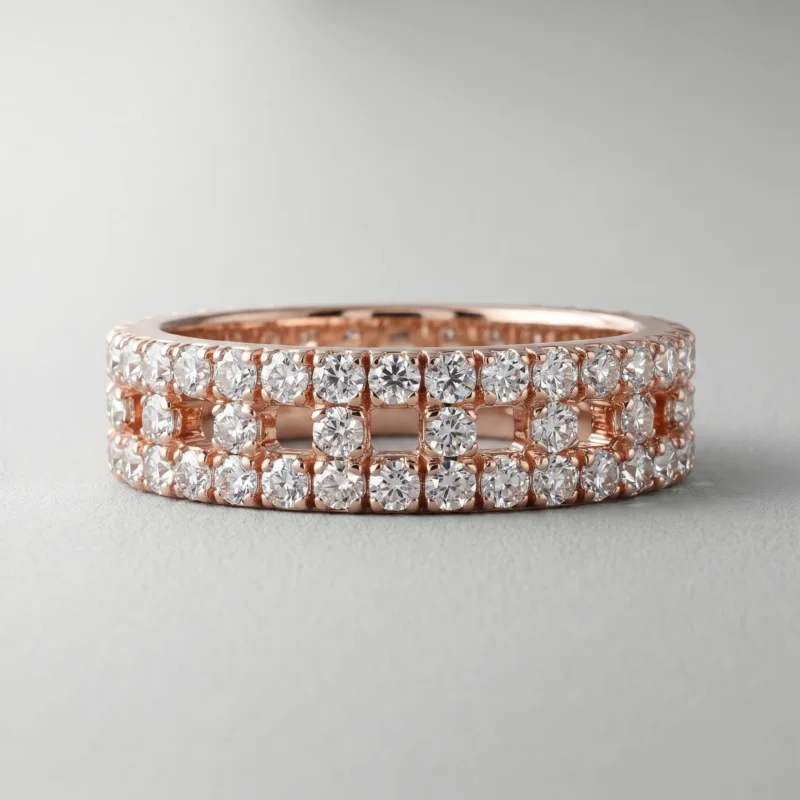
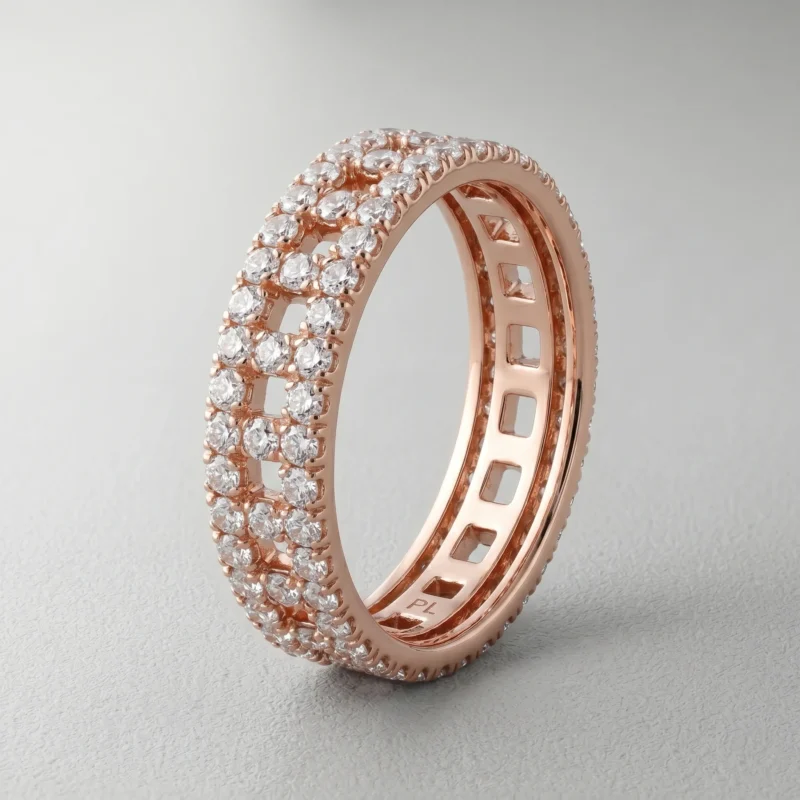
This is different from an eternity band, which is a continuous-stone design that closes on itself and typically sits as the primary band, not as part of a layered set. Eternity bands and stackable bands aren’t interchangeable — if you want the option to add rings over time without resizing complications, a stackable half-eternity or pavé band in 1.5–2mm gauge gives you that flexibility. A full eternity band, once sized, is fixed.
The engineering underneath a well-built stack
Gauge width and the crowding problem
A stackable band’s width is the single most consequential specification, and the correct target isn’t purely aesthetic. For a band designed to sit against an engagement ring during all-day wear, 1.5–2mm is the functional sweet spot: wide enough to hold its diamond setting securely, narrow enough that it doesn’t press laterally against the engagement ring’s basket as both rings move through their natural micro-rotation on the finger.
Wider bands — 2.5mm and above — aren’t stackable in the strict sense. They can be stacked against a plain metal band or a wide-shank engagement ring, but next to a standard prong-set engagement ring, a 2.5mm+ band starts creating the lateral pressure problem. The outer wall of the stackable band pushes against the side of the basket, and over months of daily contact, that pressure transfers to the prong tips.
Curved vs. straight — the actual decision
This is framed as a style choice almost everywhere, and it has a style dimension, but it’s primarily a geometry decision.
A straight band sits flat on both the inner and outer surfaces. It fits cleanly against a high-set engagement ring (six-prong Tiffany style, cathedral shank, tall basket) because the basket clears the band’s surface and there’s no contact point creating friction. If the engagement ring is low-profile — bezel-set, flush-set, or any setting where the stone sits close to the shank — a straight band will leave a visible gap on either side of the stone, because the flat inner surface can’t follow the ring’s shoulder contour.
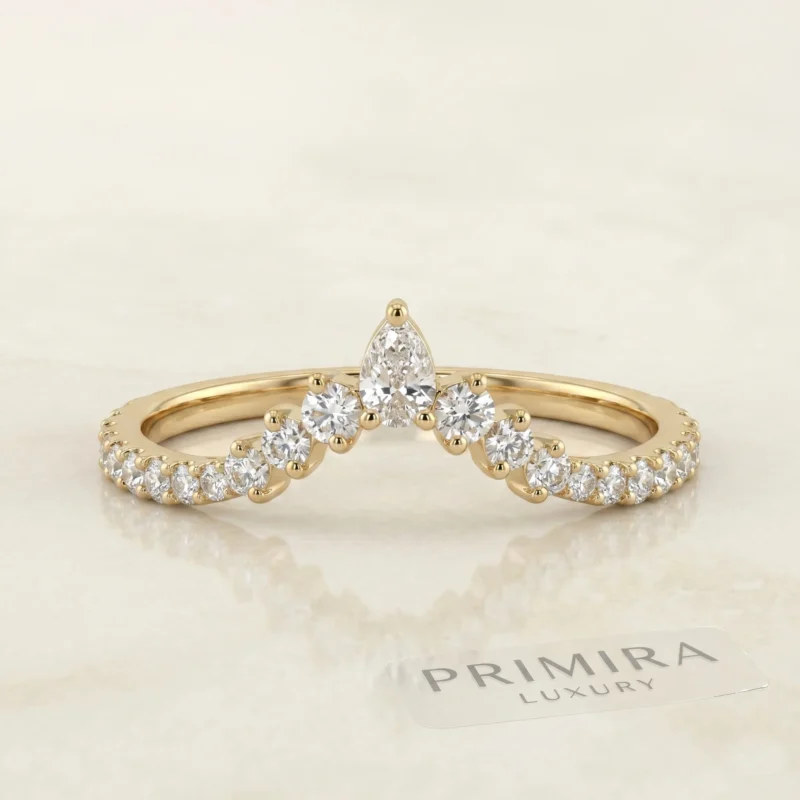
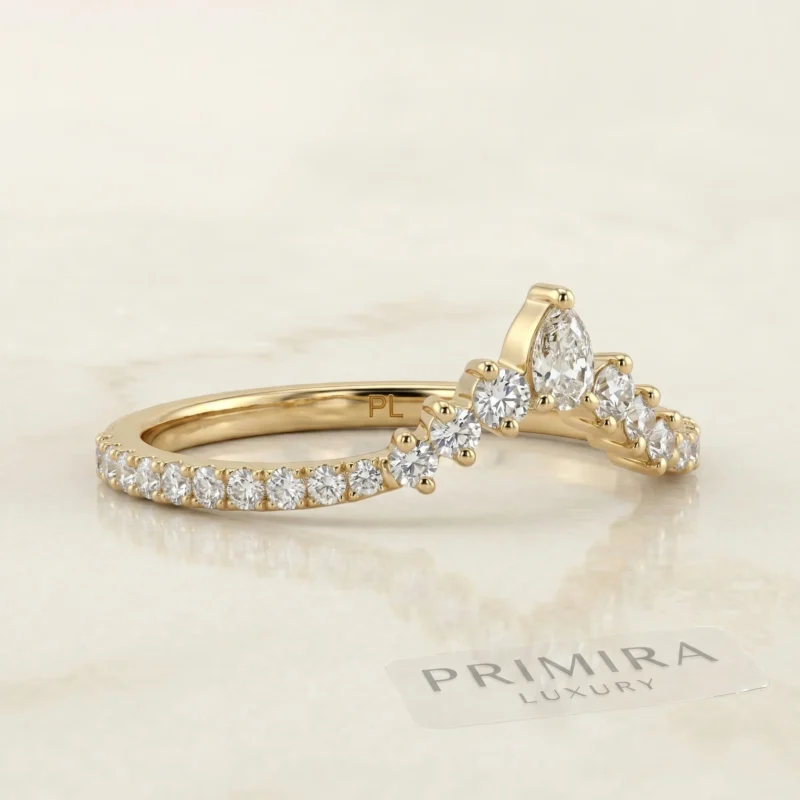
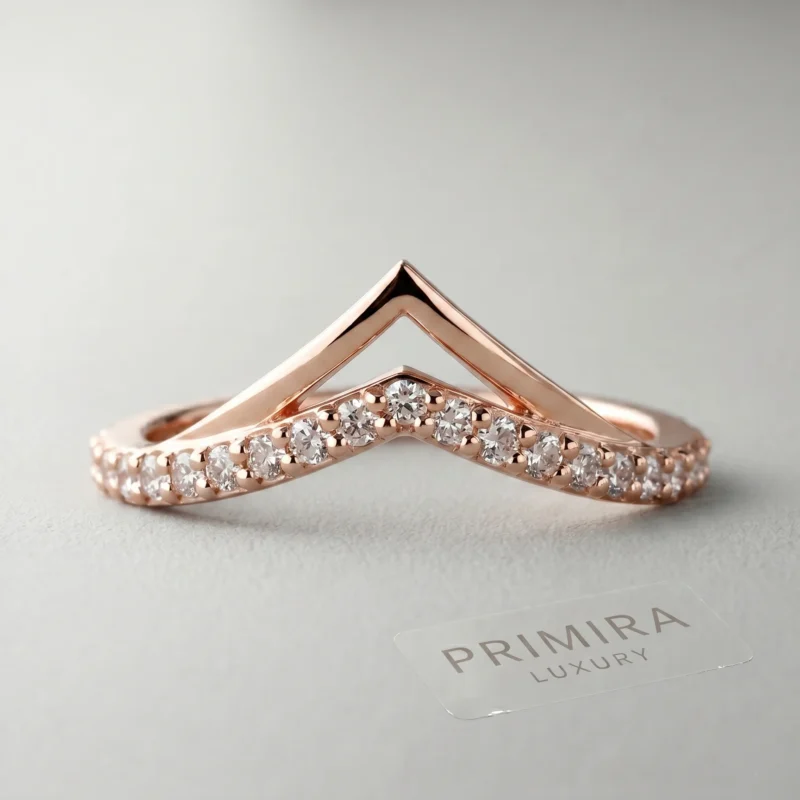
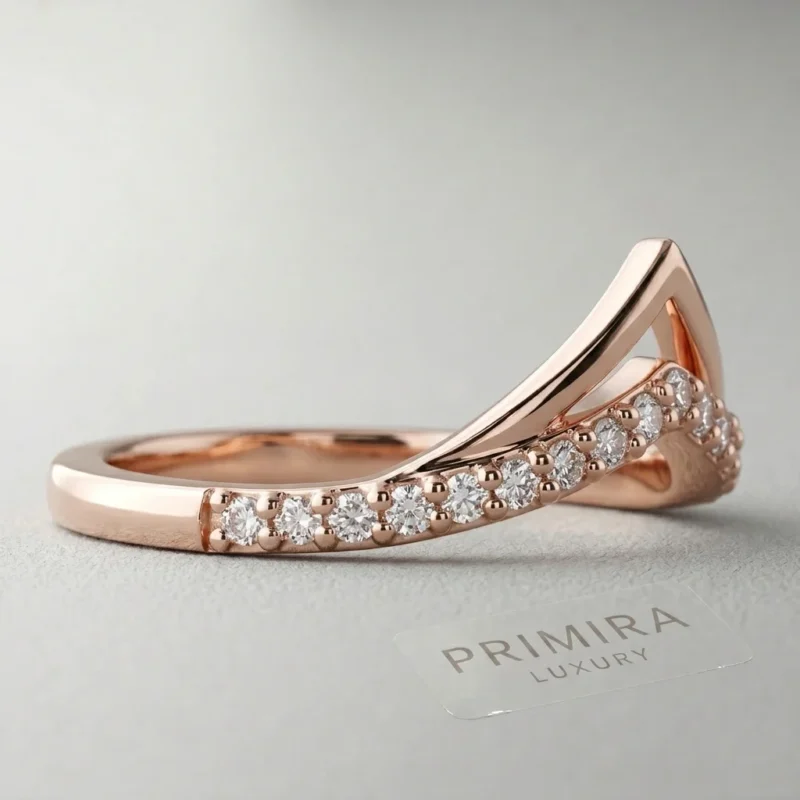
A curved band has an inward arch on the inner face, shaped to travel around a stone setting. The depth of the curve is calibrated to the height of the prong basket it needs to clear. Too shallow and it still leaves a gap; too deep and the inner arch contacts the basket directly, creating its own wear problem. When Primira produces a curved stackable band as part of a matched order, the arch depth is set to the actual basket height of the engagement ring it will sit against — not to a generic solitaire average.
Metal-on-metal wear in a permanent stack
Rings in daily contact wear each other. The rate depends on the alloy hardness of both pieces. Platinum (Vickers hardness ~200HV) and 14K gold (approximately 120–165HV depending on alloy) wear at different rates, which creates a practical rule: a platinum stackable band worn daily against an 18K gold engagement ring will eventually abrade the softer ring’s outer surface at the contact edge. The reverse pairing is less common — gold bands next to a platinum engagement ring — but produces the same result.
The cleaner approach is alloy-matched stacking: 14K with 14K, 18K with 18K, platinum with platinum. If you want to mix metal tones (yellow gold engagement ring with a white gold stackable, for instance), matching the karat tier keeps the wear rate even across both rings. A 14K yellow gold engagement ring against a 14K white gold stackable band will wear symmetrically. A 14K yellow against an 18K white will wear asymmetrically, the softer 14K losing surface faster.
Diamond specifications for stackable bands
The stone specification on a stackable band is driven by its role in the stack — supporting the engagement ring’s visual character rather than competing with it. For a solitaire engagement ring, a micro-pavé stackable in D–F colour at VS1–VS2 clarity matches the engagement ring’s stone quality in the one dimension that matters most: colour. Two bands on the same hand where one reads white and the other reads slightly warm create visual dissonance that’s immediately noticeable.
Primira’s standard stackable bands carry the same D–F colorless and G–H near-colorless colour tiers as the rest of the lab grown diamond wedding band collection, with Ideal and Excellent cut grades only. Clarity in a 1.5–2mm stackable pavé band runs VVS1–VS2 — all eye-clean at the scale these stones appear in a tight stack.
For a fancy colour engagement ring — yellow, pink, or blue lab grown diamond centre — the stackable band can go two directions: match the metal tone to amplify the colour (yellow gold band against a yellow diamond engagement ring deepens the warmth of both), or use a white metal band as a contrast frame. Both work; what matters is that the decision is deliberate rather than default.
Setting types for stackable bands
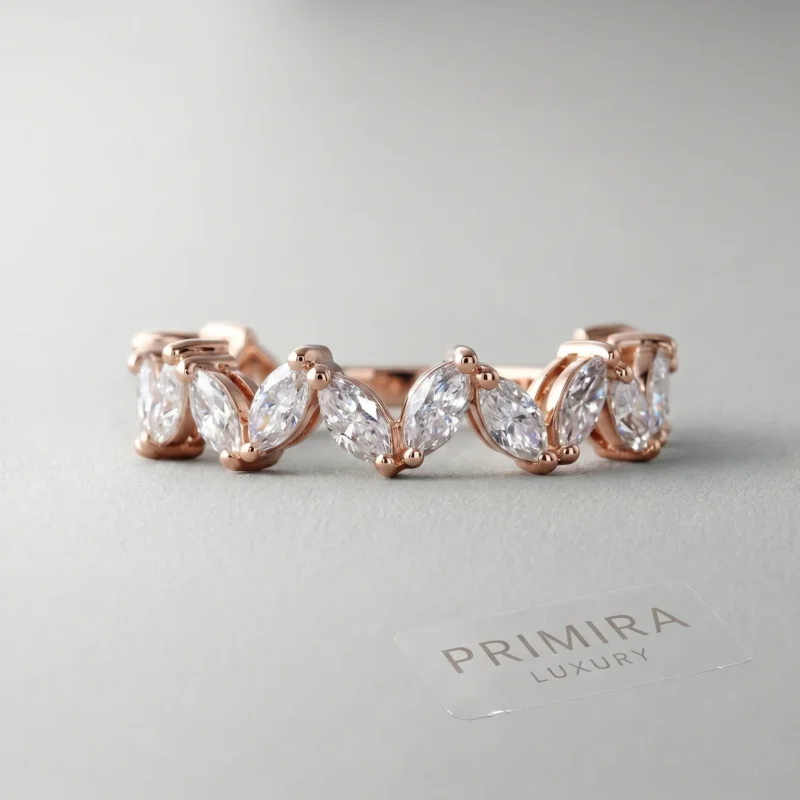
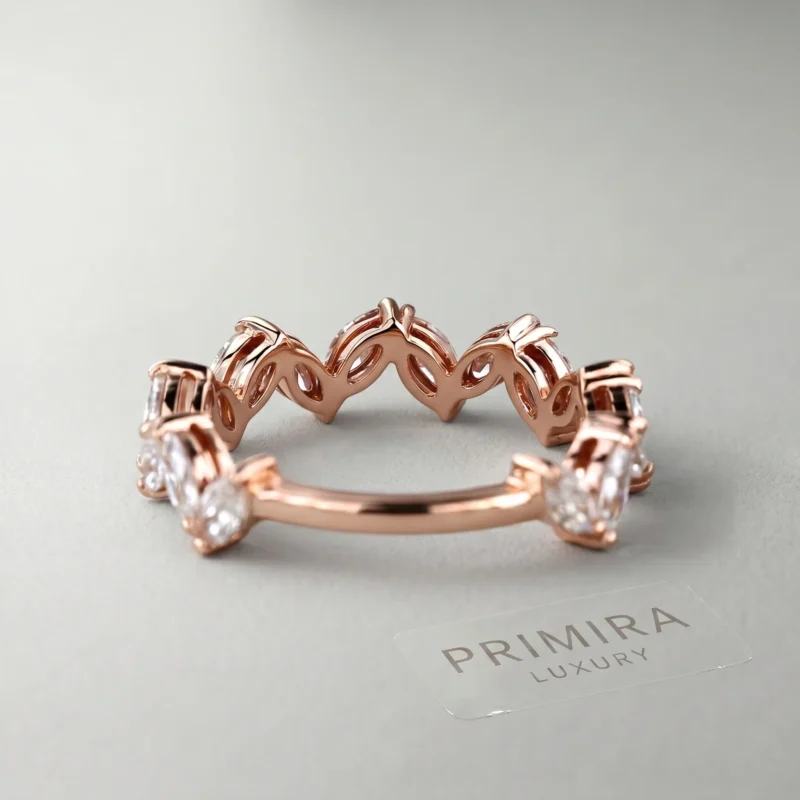
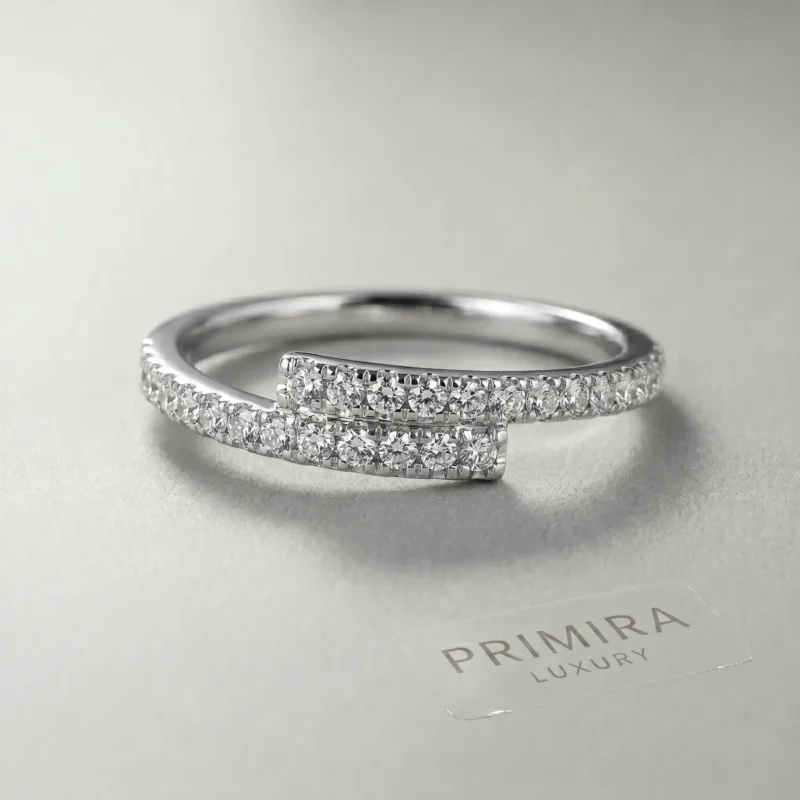
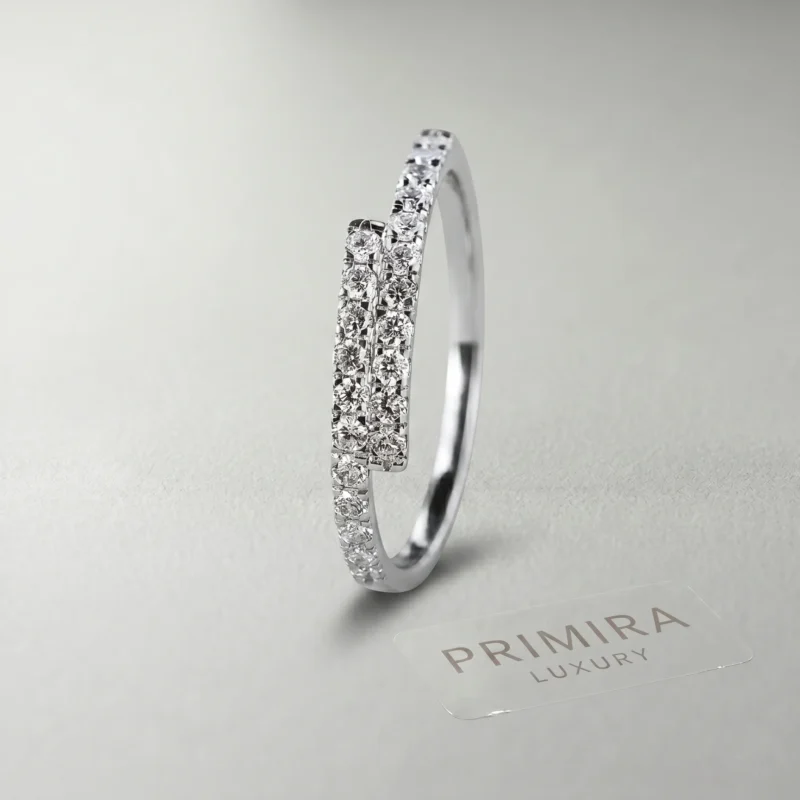
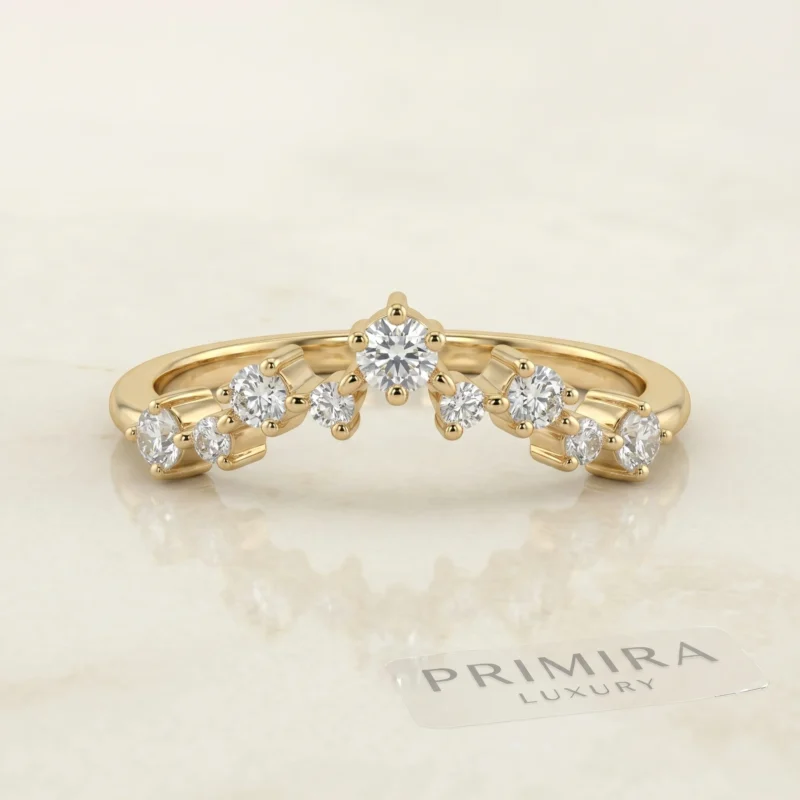
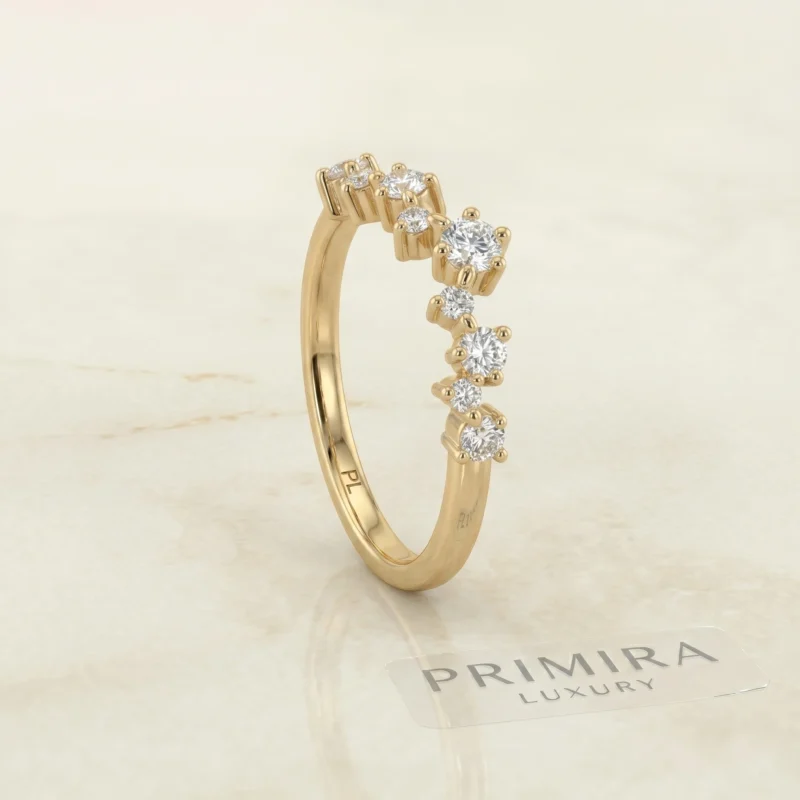
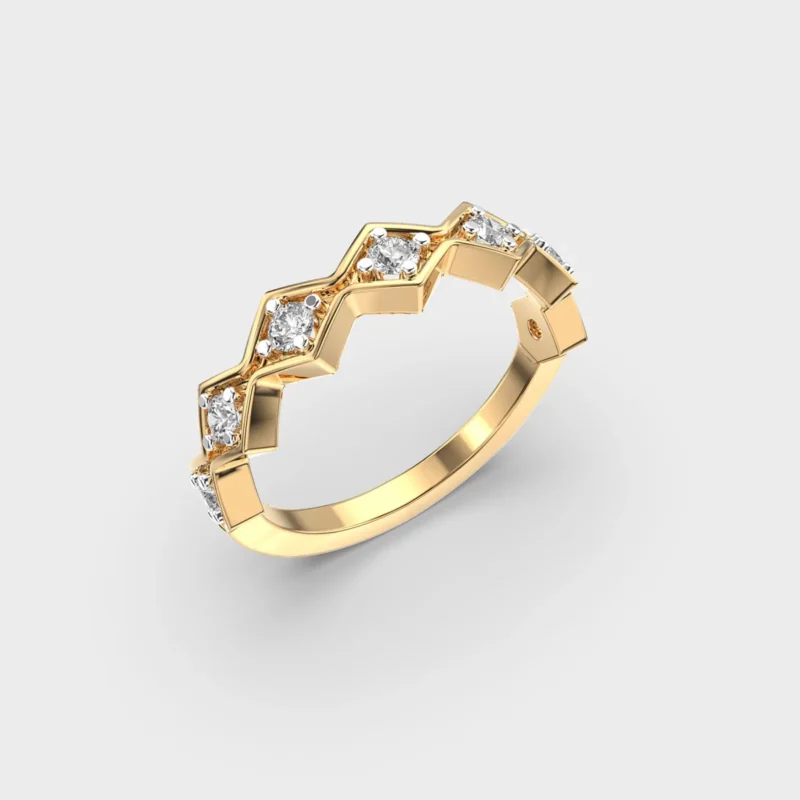
Micro-pavé (shared-prong): The most common setting for a 1.5–2mm stackable. Tiny lab grown diamonds are set across the top face of the band in closely spaced prong groups. The low profile of micro-pavé keeps overall band height minimal, which is exactly what’s needed when the stackable needs to clear the engagement ring’s shoulder without adding height to the stack.
Channel set: Diamonds sit in a groove between two metal walls, with a flush exterior — no prongs protruding above the surface. Channel-set stackable bands are the most abrasion-resistant option because there are no prong tips to catch. For buyers who do active work with their hands, a channel-set stackable in 14K gold holds up better over time than a pavé band where small prong tips, if they loosen, can catch fabric.
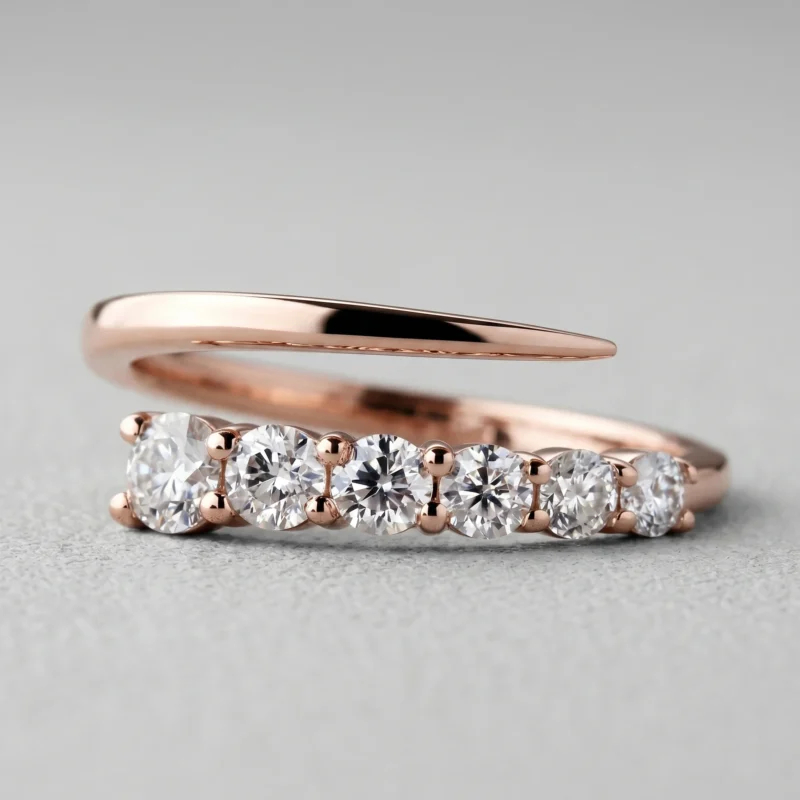
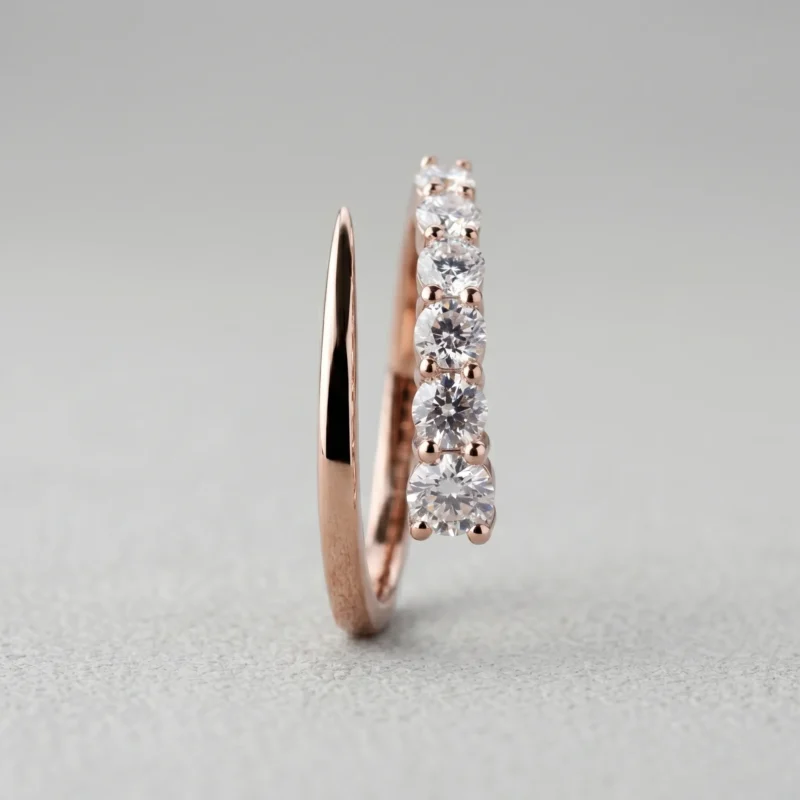
Half-eternity (top-only): Diamonds run across the top 180° of the band, leaving the bottom half as plain metal. This is the configuration that remains resizable — because the diamond-free lower section can be cut and sized in the standard way. For a stackable band you’re adding now and may need to resize in 10 years, half-eternity is the more practical specification than full-eternity in a 1.5–2mm gauge.
Building a stack over time
A stack doesn’t have to be assembled at once. Many of the best stacks are built across years — wedding band first, then an anniversary band at five years, then a milestone band at ten. The engineering consequence: if there’s a possibility of a third band joining the stack later, the first two bands need to leave physical room for it. Two 1.5mm bands take up 3mm of shank space; adding a third means 4.5mm total, which starts to feel substantial on most fingers and may require sizing up by a half-size for comfort.
Planning for future additions doesn’t require making a decision now. The pre-production specification confirmation via WhatsApp — which happens within 24 hours of every order — is the right moment to flag this: “I plan to add an anniversary band later” is exactly the kind of information that changes which gauge width, which curve depth, and which metal pairing we’d recommend for the first stackable band.
Lab grown diamonds make this kind of incremental building financially realistic in a way that matters: adding a 0.30–0.50ct pavé stackable at a fifth anniversary, when it might otherwise have been a plain metal band, is a different category of accessible.
Stackable bands vs. eternity bands — the direct comparison
Both are band-style rings set with lab grown diamonds. The differences are structural, not just stylistic.
An eternity band runs diamonds 360° around the shank. It can’t be resized once set. It’s designed as a primary band, typically worn as the wedding band itself, not alongside a second or third ring — though it can be stacked against a plain metal band. The stone specification is more demanding because colour matching across the full circumference is visible from every angle.
A stackable band in half-eternity or pavé configuration sets diamonds across the top face only. It can be resized. It’s designed to sit against other rings. Its visual contribution is sparkle at the top of the stack — the part visible when you look down at your hand — rather than full-circumference coverage. The carat weight is lower and the price is lower, which is part of why the stackable format is the more common choice for milestone purchases added over time.
Which one serves you depends on what you already own and what you’re building toward, not on one being better than the other.
How a Surat manufacturing facility approaches a custom stackable
The advantage of ordering a stackable band from the same facility that made the engagement ring isn’t philosophical — it’s mechanical. The lapidary and the bench team have the ring’s actual specifications: basket height, prong wall thickness, shank profile at the shoulder. The stackable band’s inner curve is calibrated to those numbers, not to a standard average.
For buyers whose engagement ring came from a different manufacturer: the same precision is available via measurement and reference photos. The pre-production WhatsApp confirmation covers this specifically — prong-basket height, preferred gap or contact between the two rings, setting height clearance needed for the engagement ring’s shoulder detail. These variables get resolved before production starts, which is the only point at which they can actually be resolved. Adjusting a band’s inner curve after it’s been cast is a bench job that works sometimes and doesn’t work others; building it right the first time is the only reliable path.
Surat processes the rough diamonds, cuts the lab grown stones, and sets them in the bands at the same facility. The chain doesn’t pass through a distributor, a wholesaler, or a retail buyer’s margin layer — which is the direct reason a Primira stackable band at this specification level is available at a price point that would read as wholesale in most other markets.
Care for a stacked set
Stacking creates more contact surface than wearing rings separately, which changes the care requirements slightly.
Metal-on-metal contact points accumulate residue faster than exposed surfaces — soap, lotion, and skin oil collect in the gap between bands and can, over months, cause the contact edge to develop a slightly duller surface. Cleaning the full stack with warm water and a soft brush weekly, running the bristles through the gap between bands, keeps this from building up.
If mixing metals in the stack, remove all rings together for cleaning rather than cleaning each ring separately, so you can check the contact surfaces between metals as part of the same step. This is also when you’d notice early signs of differential wear — a slight surface difference at the contact edge — which is easier to address at the polishing stage than after years of uninterrupted contact.
Platinum-to-gold contact: platinum develops a patina (a fine surface texture from micro-scratching) at the contact edge, while gold polishes smooth. Neither process damages the structural integrity of either ring, but if you prefer both rings to stay high-polish, periodic professional re-polishing — once every two to three years under normal wear — keeps the contact edges consistent.
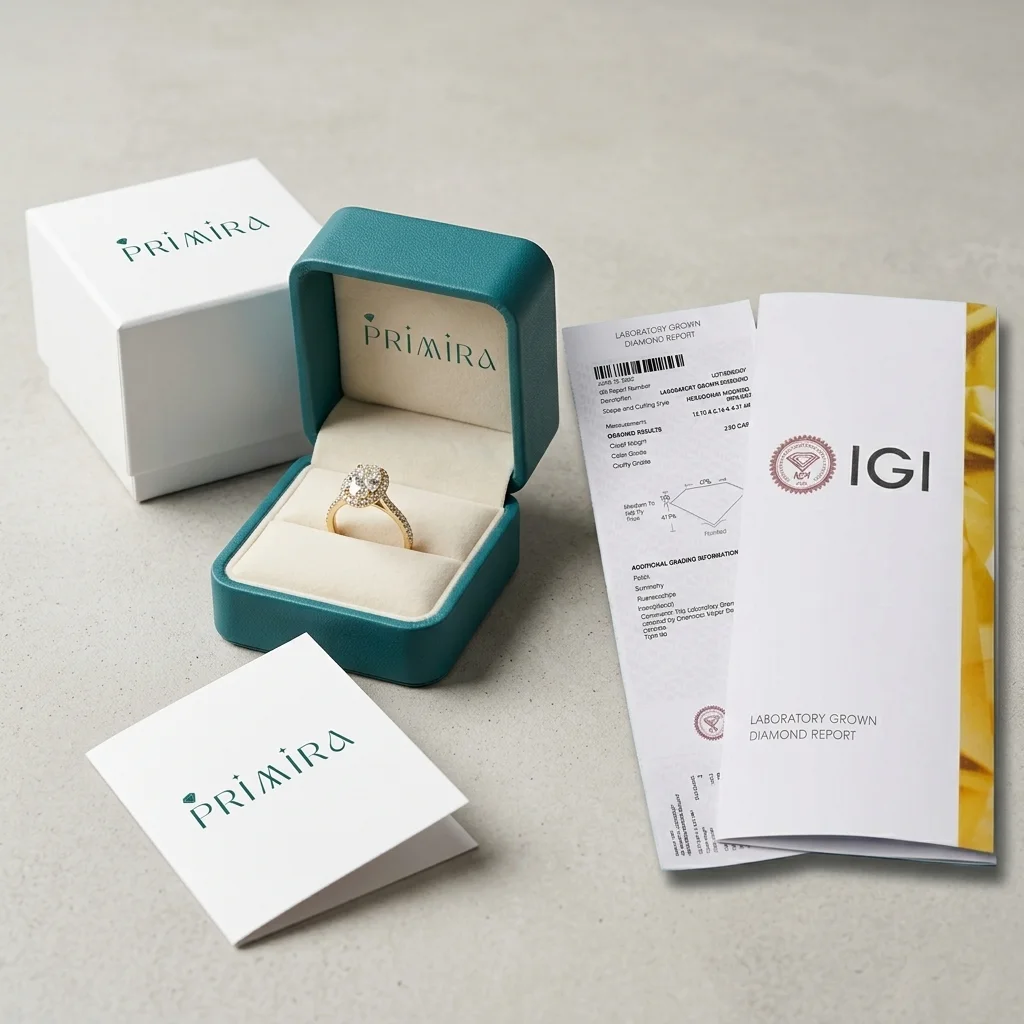
IGI certification for a stackable band documents the diamond specifications — colour, clarity, cut — at the time of production. The report number is laser-inscribed on the girdle of each stone above a certain carat weight, verifiable at igi.org. This matters for insurance documentation and for resale value assessment, both of which apply to a ring that becomes part of a permanent wearable set over years.
Frequently asked questions
Can a stackable band be added to an engagement ring from a different manufacturer?
Yes. The pre-production confirmation process gathers the information needed to calibrate the inner curve and setting height to your engagement ring regardless of where it was made. Reference photos from three angles (top, side, front) plus the ring’s band width and prong-basket height — which a jeweller can measure in minutes — are enough to produce a stackable band that fits properly.
What’s the difference between a straight stackable band and a curved one?
The difference is functional, not primarily aesthetic. A straight band is the correct choice when the engagement ring has a high-set basket — six-prong solitaire, cathedral shank — because the basket clears the band’s flat inner surface. A curved band is the correct choice when the engagement ring has a low-profile setting, side stones at the shoulder, or a halo, where a straight band would leave a visible gap or create uneven contact. If you’re unsure, a reference photo of your engagement ring from the side (showing the basket height and shoulder profile) makes this clear.
Do stacked rings damage each other?
Metal-on-metal contact causes gradual wear in any permanent stack — the rate depends on alloy hardness. Alloy-matched stacking (same karat tier for both rings) keeps the wear rate even between the two pieces. The more damaging scenario is rings that don’t fit cleanly and press laterally against each other under movement — this creates friction at the contact point rather than the smooth surface-to-surface contact of properly fitting bands. Getting the inner profile and gauge width right at the production stage is how you prevent this.
Can I resize a stackable band after ordering?
A half-eternity stackable band (diamonds across the top half only) can be resized using standard bench methods, because the plain metal section at the base can be cut and adjusted. A full-eternity stackable band cannot be resized after the stones are set. If you’re uncertain about your ring size, or anticipate sizing changes, specify a half-eternity configuration. The pre-production WhatsApp confirmation is the right moment to flag this preference.
How many stackable bands can I wear at once?
Practically: two against the engagement ring is comfortable for most people with 1.5–2mm gauge bands. Three bands on one finger starts to approach the knuckle clearance limit and may require sizing up by half a size across the full stack. Beyond three, comfort typically wins over appearance — most people who build larger stacks wear the full collection for occasions and rotate two or three rings for daily wear.
Is a stackable band a good choice for an anniversary gift?
It’s one of the more practical anniversary gifts in fine jewellery because it adds to an existing set rather than replacing anything. The milestone purchase model — wedding band first, anniversary band at five or ten years, milestone band later — is built around exactly this format. Lab grown diamond stackable bands at 0.20–0.50ct total weight are the most common specification for anniversary additions, precisely because they’re substantial enough to read as significant and calibrated to sit alongside the original set without overwhelming it.
Ordering and what to expect
Every stackable band order begins with a specification confirmation within 24 hours via WhatsApp and email. For a stackable band, this confirmation covers: gauge width, curved vs. straight inner profile, diamond tier (colour and clarity), metal choice and tone, setting type, ring size, and — if you’re adding it alongside an existing ring — the relevant dimensions of that ring.
Production runs 15–35 business days. Certified loose lab grown diamonds already in inventory ship within 48 hours of confirmation. All shipments are insured from our Surat facility to delivery.
India: free shipping on orders above ₹10,000. International: free express shipping on orders above USD $550, standard insured shipping available otherwise.
The 7-day return window applies where the piece delivered differs materially from the confirmed specification. Made-to-order pieces with custom inner profiles are final sale under standard policy, but specification mismatches are covered — and the pre-production confirmation process is specifically designed to prevent those from occurring.
View the full lab grown diamond wedding band collection to see eternity, stackable, and bridal-set options together, or the matching bridal ring sets if you’re building the engagement ring and band at the same time.










 1-to-1 Custom Design
 Craft Your Vision
 HD video Preview
 Fully Customizable
 Choose Metal Tone:
 Handcrafted in Solid 10K · 14K · 18K
 Select Your Stone Type:
  Award winning
  Hallmarked &
  Personalized Care &
  Design Any Piece

 Chat on WhatsApp