
Primira Luxury Blog
“Jewelry is more than an accessory; it’s a timeless tale waiting to be told.”
“Like a well-crafted gem, true beauty comes from within. Let your jewelry amplify it.”


Discover Your Perfect Price
Filter by Stone Type and Metal to view accurate, variation-based pricing
Transparent, personalized, and effortless - explore designs that match your style, metal, and budget.
- Tip: Choose one stone type and one metal type to see your exact price.
- If prices seem off, just uncheck and re-apply your filters – the page will refresh with accurate pricing.
 1-to-1 Custom Design
Experience
 Craft Your Vision
Today with a 10% Starte
 HD video Preview
Before It Ships
 Fully Customizable
- Stone, Metal & Budget
 Choose Metal Tone:
Yellow, White or Rose Gold
 Handcrafted in Solid 10K · 14K · 18K
Gold, 925 Silver or 950 Platinum
 Select Your Stone Type:
 Lab-Grown Diamond or Moissanite
 Award winning
 craftmanship and detailing
 Hallmarked &
 Certified (IGI / SGL)
 Personalized Care &
 Expert Support
 Design Any Piece
Within Your Budget
1-to-1 Custom DesignExperience
Craft Your VisionToday with a 10% Starte
HD video PreviewBefore It Ships
Fully Customizable- Stone, Metal & Budget
Choose Metal Tone:Yellow, White or Rose Gold
Handcrafted in Solid 10K · 14K · 18KGold, 925 Silver or 950 Platinum
Select Your Stone Type: Lab-Grown Diamond or Moissanite
Award winning craftmanship and detailing
Hallmarked & Certified (IGI / SGL)
Personalized Care & Expert Support
Design Any PieceWithin Your Budget
Primira's
Real Reviews From Real Customers
Lifetime
Warranty
100% Money
Back Guarantee
Easy
Customization
7 Days
Return
14 Days
Exchange
Insured
shipping
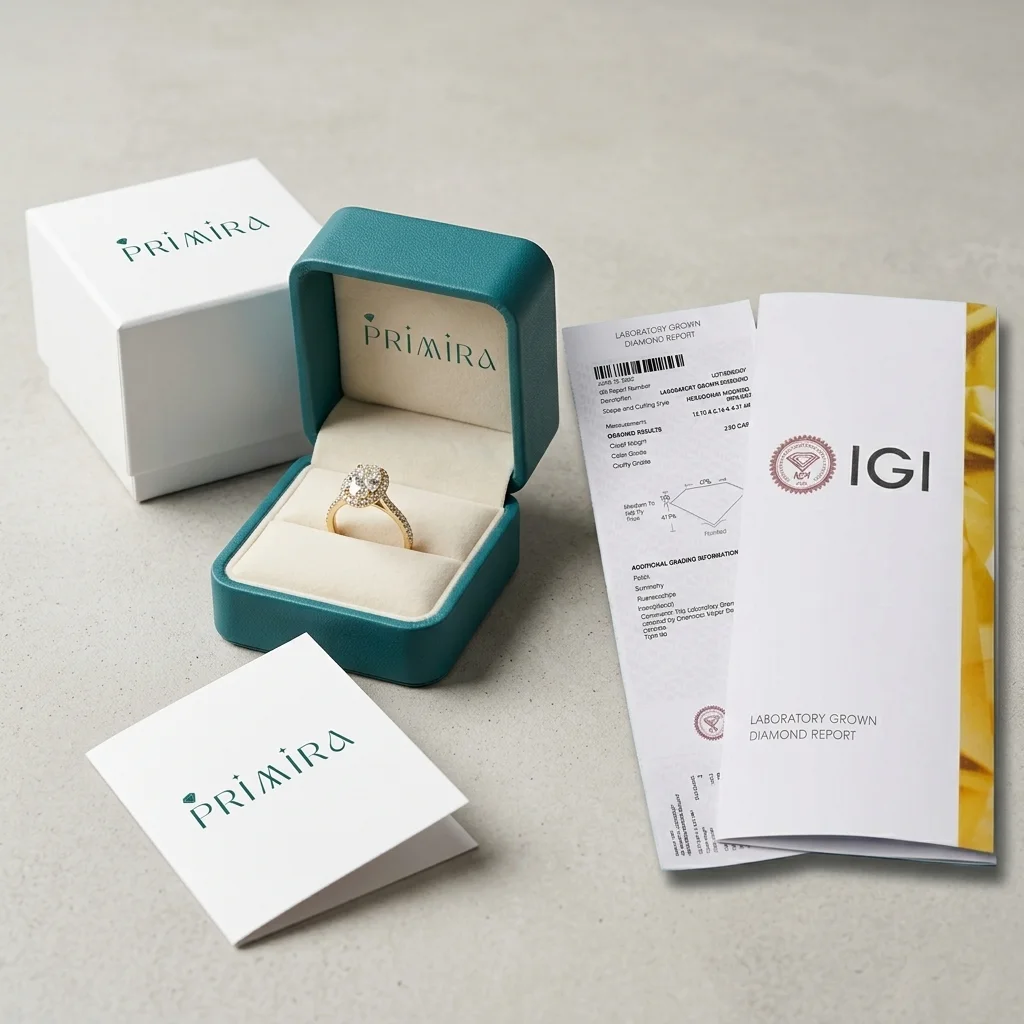
sustainable, beautiful packaging
Give your precious pieces a home they deserve with our stylish, soft-lined jewelry boxes made for effortless organization.
Read Our Article Behind Every Collection
Each design at Primira Luxury is handcrafted with precision, purpose, and emotion. From the first sketch to the final polish, our artisans turn your vision into a piece that feels personal, ethical, and timeless.
Read More
Men’s Lab Grown Diamond Earrings
A diamond stud for a man needs to work harder than a piece that comes off at 6 PM. It should be on at the gym and look right in a board meeting. It should handle physical work without the prong catching on a towel, and it should stay secure on a fourteen-hour flight. If you’re buying a lab grown diamond earring for daily wear, the question that matters most isn’t which carat size looks impressive — it’s which setting keeps the stone protected, low-profile, and genuinely unobtrusive until you want it noticed.
That’s what this page is about: how the setting shape determines what the stone can handle, how a single certified stone gives you a clean, verifiable purchase rather than the paired-match complexity of women’s studs, and how Surat’s lapidary gives you stone depth and face-up calibration that off-the-shelf catalog pieces don’t offer.
Setting Types for Men’s Diamond Earrings
Setting choice for a man’s earring isn’t a style preference — it’s a daily-life decision. Three settings do most of the work in men’s fine jewelry, and each solves a different problem.
Bezel setting wraps a complete metal rim around the stone’s perimeter. There are no prongs to catch on fabric, no exposed girdle, no way for the diamond to work loose from a knocked-against surface. The stone sits inside a metal collar and doesn’t move. This is the most protective setting available, and for a man who trains regularly, works with his hands, or travels frequently, it’s the practical default. The rim also reads as a clean geometric frame on a male wearer — the stone’s edge is defined, not softened. Available in full bezel (360° coverage) or semi-bezel (metal on two sides, maximum light entry from the open sides).
Flush / burnish setting takes protection further. The stone sits inside a drilled seat in the metal with no prongs, no rim above the surface — the diamond’s table sits flush with the metal face. Profile from the side: essentially zero. There’s nothing to snag, nothing projecting above the lobe. The trade-off is that less light enters from the sides, so the visual effect is a point of sparkle rather than a floating brilliant. For a man who wants something genuinely subtle — wearable professionally without anyone registering it as jewelry — flush-set is the option.
4-prong basket is the open setting that lets light flood in from every angle. Four metal claws grip the stone at the girdle; the rest of the stone is exposed. Maximum optical performance, the setting that makes a 0.50ct stone read as 0.50ct instead of reading smaller inside a metal frame. The trade-off: prongs can catch on rougher materials, and the higher profile means the stone sits away from the lobe rather than against it. The right choice for a man whose earring is part of how he presents — formal occasions, evenings, professional contexts where the look matters more than zero-maintenance wearability.
6-prong is available on larger stones (0.75ct+) where the additional grip security justifies the added metal. Same light exposure profile as 4-prong, marginally more security.
Stone Specifications for Men’s Earrings
Men’s diamond studs span 0.25ct to 1ct per stone for most everyday purposes, with 0.30ct to 0.60ct being the practical center of the range — visible enough to read from a short distance, understated enough to not read as jewelry before anything else.
Cut quality matters more on a single exposed stone than it does in a cluster or halo setting where surrounding stones compensate. Primira stocks only Ideal and Excellent cut grades — the same proportion standards applied to a round brilliant stud as to an engagement ring center stone, because cut determines how much light exits the table from across a room.
Clarity: VVS1 to VS2 across the full range. No SI2 or lower. A stud stone is worn at face-adjacent distance and examined up close far more often than a ring stone — clarity visibility matters here.
Color: D-F colorless as primary stock. G-H-I near-colorless for buyers looking for maximum carat per budget with no visible color difference to the naked eye.
Stone shapes: Round brilliant is the natural choice for men’s studs — 57-58 facets, symmetrical face-up, no directional orientation issue in the setting. Princess cut (square) is the second most popular men’s shape — the 4-prong basket setting suits it naturally, the geometric profile reads deliberately structured. Black lab grown diamonds work in a flush or bezel setting specifically — the black surface reads as a clean matte point rather than a reflective stone, closer to a flat metal accent than a traditional diamond.
One Stone or Two
Most men’s earring buying guides treat one ear vs. two as a cultural or style question. From a production perspective, there’s a practical one.
A single stone purchase is straightforward: one IGI report, one girdle laser inscription, one stone’s specifications confirmed in writing before production. If you’re buying from a screen without seeing the stone in person, a single-stone purchase gives you cleaner verification than a matched pair — there’s one object with one report number to check at igi.org.
A paired purchase (both ears) introduces the same matched-pair considerations that apply to women’s studs: color temperature must align across both stones, face-up diameter should match within 0.10mm, cut-grade light return should be comparable so both read equally bright under the same lighting. Primira manages this from stone selection — matched parcels from the same growth cycle batch — but the specification confirmation at production stage becomes a two-stone conversation rather than a single-stone one.
For a first purchase, single stone is the simpler entry point. For buyers who want symmetry across both ears, the pre-production WhatsApp confirmation covers both stones’ specs simultaneously — the same process a women’s stud pair goes through.
Carat and Face-Up: Getting the Size Right
A 0.30ct round brilliant has a face-up diameter of approximately 4.3mm. A 0.50ct is approximately 5.1mm. A 1ct is approximately 6.5mm. These are meaningful differences on a male earlobe, where a larger stone projects further from the lobe and is visible from a greater distance.
The standard advice — “choose a carat size that suits your face” — is less useful than thinking about projection distance. In a 4-prong basket, a 0.50ct stone sits above the lobe; in a bezel, the same stone sits tighter. In a flush setting, the face-up diameter reads differently than the same stone in an open setting because there’s no metal frame extending the apparent perimeter.
One thing Surat lapidary makes possible that catalog-stock purchasing doesn’t: depth calibration. A stone cut to a tighter pavilion depth carries more visual mass in the face-up view relative to its carat weight. A deeper stone of the same carat weight appears smaller face-up but has more mass. For a men’s stud where lobe projection matters, requesting a shallower pavilion — more face-up spread for a given carat — is a production-level adjustment that can only come from a lapidary who cuts the stone to specification, not one who selects from existing inventory. This is the kind of request the pre-production WhatsApp confirmation handles.
Metal Options
14K gold (58.5% gold) is the standard for men’s earrings: high tensile strength, scratch-resistant, durable through regular contact. Yellow gold suits warmer skin tones and reads as a deliberate choice — particularly with a bezel setting where the metal frame is visible. White gold suits cooler preferences and recedes against the stone. Rose gold is available but less common in men’s fine jewelry.
18K gold (75% gold) is the premium tier — richer hue, slightly softer, the correct metal for high-quality settings where structural integrity is not compromised by the softness increase at this level.
Platinum (950) is the default for serious daily-wear pieces: densest, highest scratch-resistance over years of continuous contact, naturally hypoallergenic. The correct choice for anyone with a nickel sensitivity or who plans to wear the earring continuously without removal.
925 silver is available for fashion-adjacent pieces — lighter weight, bright reflective surface, not the correct choice for continuous daily-wear where durability matters.
IGI Certification for a Single Stone
Each lab grown diamond stud from Primira carries an IGI certificate — for a single stone, this means one report covering cut grade, color, clarity, carat weight, and symmetry. The report number is laser-inscribed on the stone’s girdle, invisible to the naked eye, verifiable at igi.org. For a stone you’re buying without seeing it in person, this is the mechanism that makes remote purchasing rational rather than a matter of trust.
For men’s earrings specifically: a single-stone IGI report is the cleanest verification structure available. There’s one stone, one number, one independent grading record. The same grading standard applied to engagement ring center stones is applied to a 0.30ct stud — Primira does not stock an alternate quality tier for the men’s category.
Care for a Men’s Diamond Earring
The genuine vulnerability in a men’s stud is the setting-to-post junction, not the stone. Prong tips can flex over years of daily wear; a bezel rim can develop a micro-gap if the earring regularly takes impact against hard surfaces. Every six to twelve months for a worn-daily piece: have the setting checked by a jeweller. The metal holding the stone requires maintenance. The stone itself does not.
For screw-back posts: tighten before strenuous activity. Not overtightened — the thread needs to engage cleanly. A screw-back that becomes difficult to remove is either cross-threaded or needs the thread track cleaned of buildup. Don’t force it; bring it to a jeweller.
For flush-set stones: clean with a soft toothbrush and warm soapy water. Flush settings accumulate skin oil in the seam between stone and metal more readily than open settings. An ultrasonic cleaner is safe for a bezel or 4-prong setting; ask before using one on a flush-set piece as it can affect adhesive if any was used in setting.
Custom Orders for Men’s Earrings
The most useful custom-order detail specific to men’s earrings: post gauge and post length. Standard posts suit most lobes, but thicker lobes — more common in men than women due to cartilage density differences that increase with age — need a longer post, or the butterfly back or screw-back mechanism presses into the skin behind the ear. This is specifiable at the production stage, not after the fact.
Other confirmable variables: stone depth/face-up calibration (as above), setting type (bezel/flush/4-prong), metal tier and tone, and whether the piece is a single stud or matched pair. For a matched pair, both stones’ IGI grades and face-up diameters are confirmed simultaneously before cutting begins.
Every order is confirmed via WhatsApp before production starts. For a men’s earring, the confirmation call covers the one or two stones, setting type, carat/clarity/color, metal tier, and post gauge — the full spec, not just a style selection.
FAQ
Which setting is best for men’s diamond earrings?
It depends on lifestyle. Bezel or flush for physically active wear, gym use, or travel — both protect the stone completely and have no prongs to catch on fabric or equipment. 4-prong for formal and evening contexts where optical performance matters more than zero-maintenance wearability. Most men with a single earring choose bezel for everyday wear and rotate to a 4-prong setting for events.
Is screw-back or push-back better for men?
Screw-back for stones of 0.50ct per ear or larger — the additional security is relevant at that weight, and men who don’t remove earrings daily benefit from the screw-back’s resistance to vibration-loosening (from activity, travel, sleep). Push-back is adequate for smaller stones in lighter everyday pieces. Primira sets screw-back as the production default for men’s studs at 0.50ct+; confirm during the pre-production WhatsApp if you prefer otherwise.
Can I wear a diamond stud in one ear only?
Yes, and from a production standpoint it’s the simpler purchase: one stone, one IGI report, one specification to confirm. Single-ear is the dominant men’s earring wear pattern globally. If you decide to add a matching second stone later, the production confirmation covers both stones’ face-up diameter and color-temperature match from the same parcel.
Are men’s diamond earrings appropriate for the workplace?
In most professional environments in 2026, a single bezel or flush-set stud is workplace-standard. The low-profile setting means it reads as deliberate and understated rather than as jewelry for its own sake. A 4-prong setting with a larger stone (0.75ct+) reads more prominently and may not suit conservative professional contexts — though this varies by industry and culture. Yellow gold in the Indian professional context carries different weight than platinum in a Western corporate context; specify accordingly.
What carat size should a man choose for a diamond stud?
0.30ct to 0.50ct per stone covers the practical everyday range — visible and clean without projecting significantly from the lobe. 0.50ct to 0.75ct for a stronger visual presence while remaining within professional norms. 1ct+ for buyers who want the earring to be a defining piece of their look. All are available from Primira in standard and custom-spec; the face-up calibration for each size range is worth discussing in the pre-production confirmation rather than defaulting to catalog proportions.
Can I get a black diamond stud for men?
Yes. Black lab grown diamonds are available in flush or bezel settings — the black surface reads as a matte point rather than a reflective brilliant, closer to a high-gloss metal accent. Popular with men who want the weight and hardness of diamond without the traditional sparkle register. Standard VVS-VS2 clarity and the same production confirmation process apply.
The Full Earring Range
Men’s studs sit alongside Primira’s complete earring collection. If you’re building out a collection: diamond stud earrings covers the matched-pair stud construction in detail; lab grown diamond hoop earrings covers huggie formats for men who want a close-profile hoop rather than a stud. The earring collection hub covers all styles.
Purchasing and Shipping
A single-stone men’s stud carries one IGI report — one stone, one report number laser-inscribed on the girdle, one independent grading record verifiable at igi.org. For a purchase made remotely without seeing the stone in person, that is the cleanest verification structure available. Every order is confirmed via WhatsApp within 24 hours of placement. The production confirmation covers stone specification, setting type, metal tier, post gauge, and whether the piece is single or paired — all of this before production begins. Lab grown diamond earrings are made to order: production takes 15–35 business days. Loose lab grown diamond studs already in certified inventory dispatch within 48 hours of confirmation.
All international shipments are insured from dispatch to delivery confirmation. Free express international shipping on orders above USD $550. India orders ship via Blue Dart or Delhivery; free shipping on orders above ₹10,000. Returns are accepted within 7 days of delivery where the piece delivered differs from confirmed specifications.
For men’s pendants in solitaire, geometric, or custom formats, see men’s lab grown diamond pendants.
 Chat on WhatsApp