Lab Grown Diamond Hoop Earrings — Huggie to Inside-Out
The Question Nobody Answers About Hoops
“I want diamond hoops” is one of those decisions that sounds simple until you start looking. A 10mm diamond huggie sits flush against the lobe and practically disappears into daily life. A 40mm inside-out hoop is a presence you walk into a room wearing. Between them: dozens of diameters, three distinct setting constructions, two fundamentally different closure types, and a huggie-vs-hoop distinction the industry uses inconsistently enough to genuinely confuse buyers.
Most buying guides resolve this with face shape advice. That’s a style question. The more useful question is: what is this pair of earrings actually for in your rotation? The answer to that — not your face shape — determines the diameter, the setting type, and the closure mechanism that matters.
Primira’s lab grown diamond hoop and huggie earrings are made at our Surat manufacturing facility: IGI certified stones, solid gold construction, full-circle pavé and inside-out track options from 10mm huggies to large-format statement hoops. What follows is a specific, technical guide to what distinguishes each type — and why the differences matter beyond aesthetics.
Huggie vs Hoop: Two Different Engineering Decisions
The industry uses these terms inconsistently, but the underlying engineering distinction is clear.
Huggie Earrings
A huggie sits flush against the lobe — typically 8–14mm inner diameter — and closes using an integrated click-hinge mechanism built into the earring body itself. There is no post through the piercing, no separate butterfly back. One arm carries the hinge; the other ends in a post that snaps into a catch on the opposite side. When it closes correctly, it clicks — that audible click is the sound of the post seating into the catch under spring tension.
At 8–12mm, the tolerance required for a huggie hinge to align and close cleanly without gap or misalignment is genuinely tight. A loose catch that only snap-fits (rather than locking under tension) loosens with wear. Primira’s huggie hinges are calibrated for a true tension-lock engagement — the post seats into the catch under spring pressure, not just gravity — which is what separates a huggie that stays put through an active day from one that works itself open.
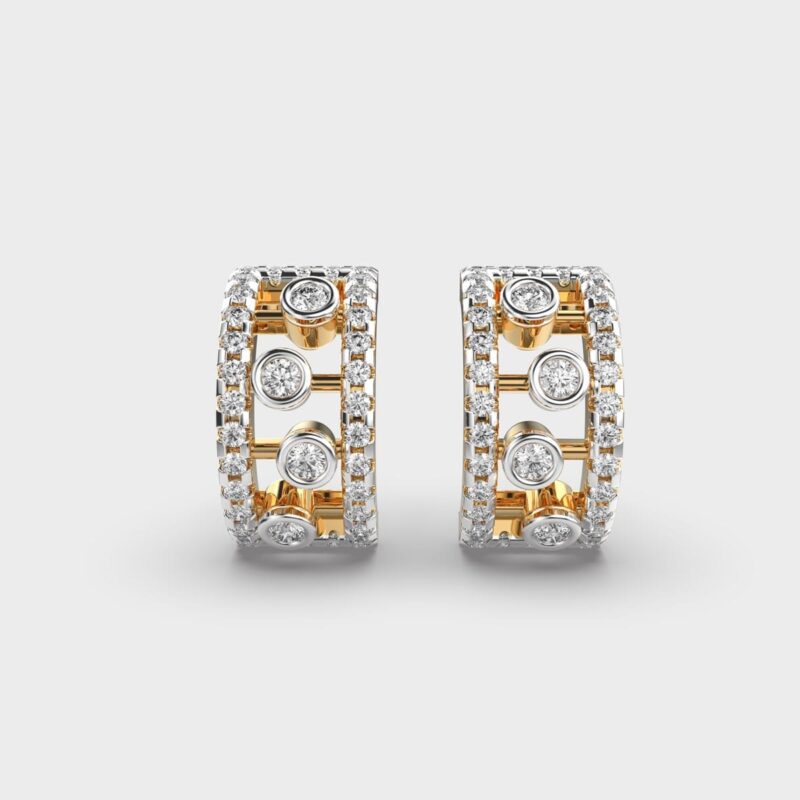
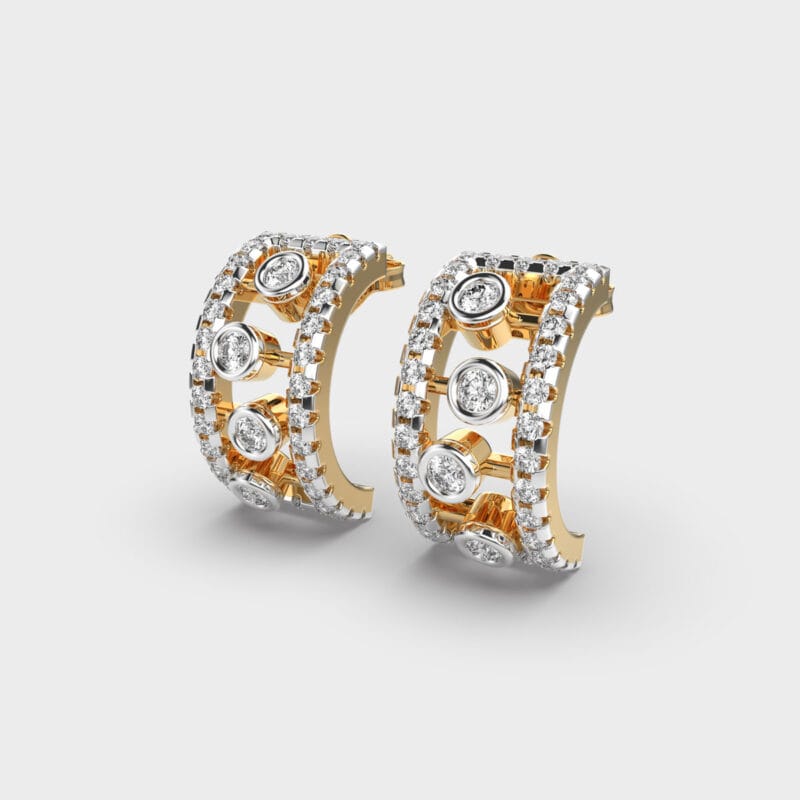
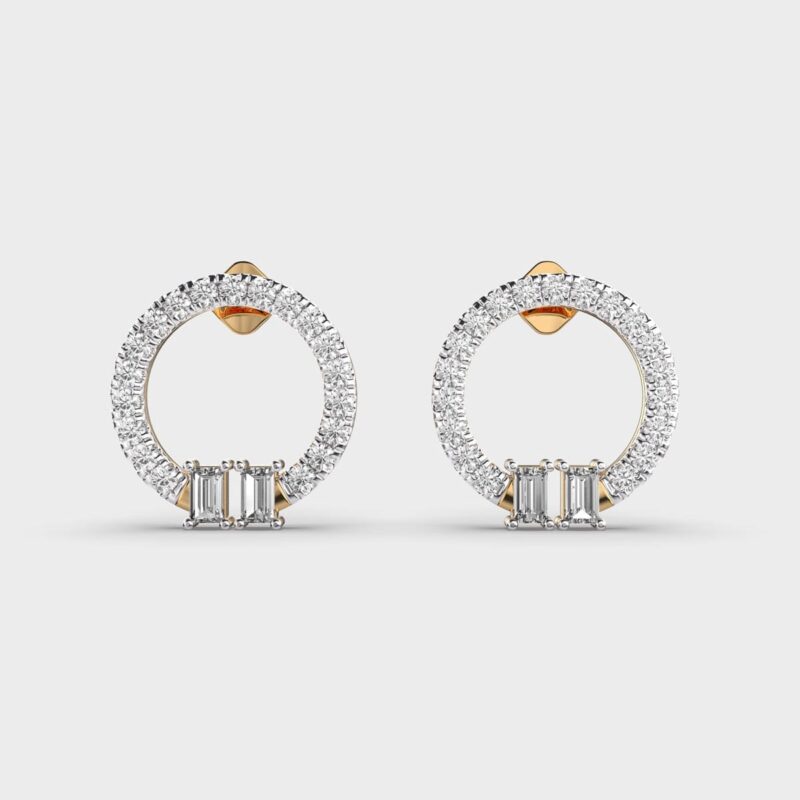
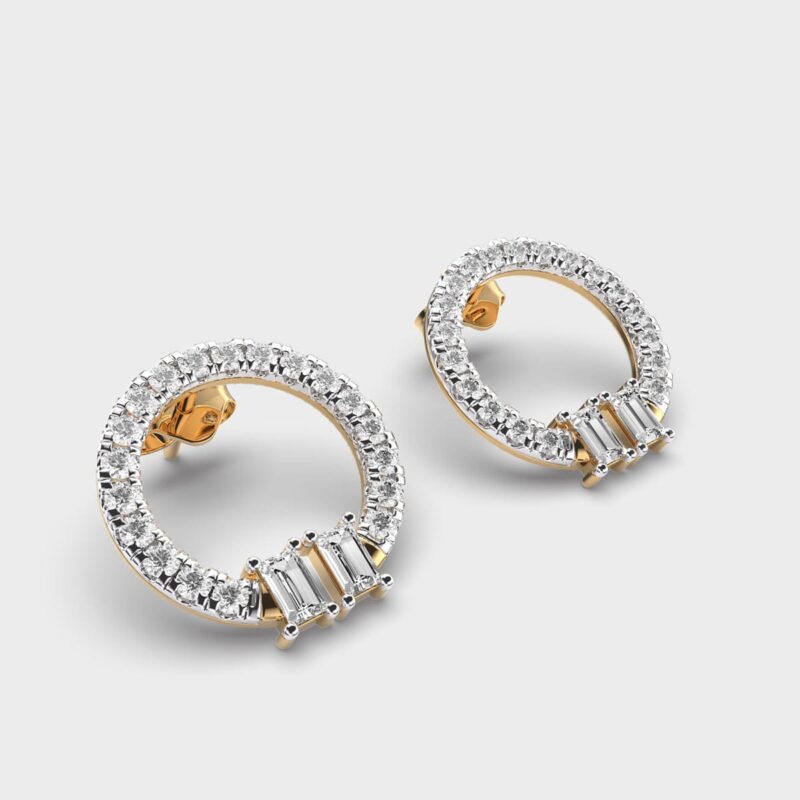
For diamond huggies specifically, the setting runs around the exterior face of the hoop. Pavé or shared-prong rows on a 10–12mm diameter mean each stone sits on a curve with a tight radius — stone spacing has to account for the curvature or the melee will appear crowded at the inside edges and spaced at the outside. Getting this right at small diameter is a production-level calibration, not a catalog selection.
Best for: Daily wear as a standalone earring; second-piercing anchor in an ear stack; buyers who want fine jewelry comfort equivalent to “I forget I’m wearing them.”
Standard Hoop Earrings (15mm and above)
Larger hoops hang away from the lobe rather than conforming to it. The closure is typically a latch-back or hinged post — a curved post that threads through the piercing and clicks into a latch at the back. Unlike huggie closures (which are integrated into the hoop body), a standard hoop’s latch is a separate element at the piercing point, which means the hoop itself moves with the body and catches light differently as it does.
This movement is part of what makes larger hoops visually impactful — a 30mm inside-out hoop rotating slightly as its wearer turns their head is delivering a continuous light event rather than a fixed sparkle point. It is also the reason standard hoops are worn as occasion or evening pieces more often than huggies: the movement is beautiful, but it requires more awareness than a piece that simply stays put.
Best for: Evening and occasion wear; solo statement pieces; buyers who want maximum visual impact per earring.
Inside-Out Track Construction: The Setting That Actually Needs Explaining
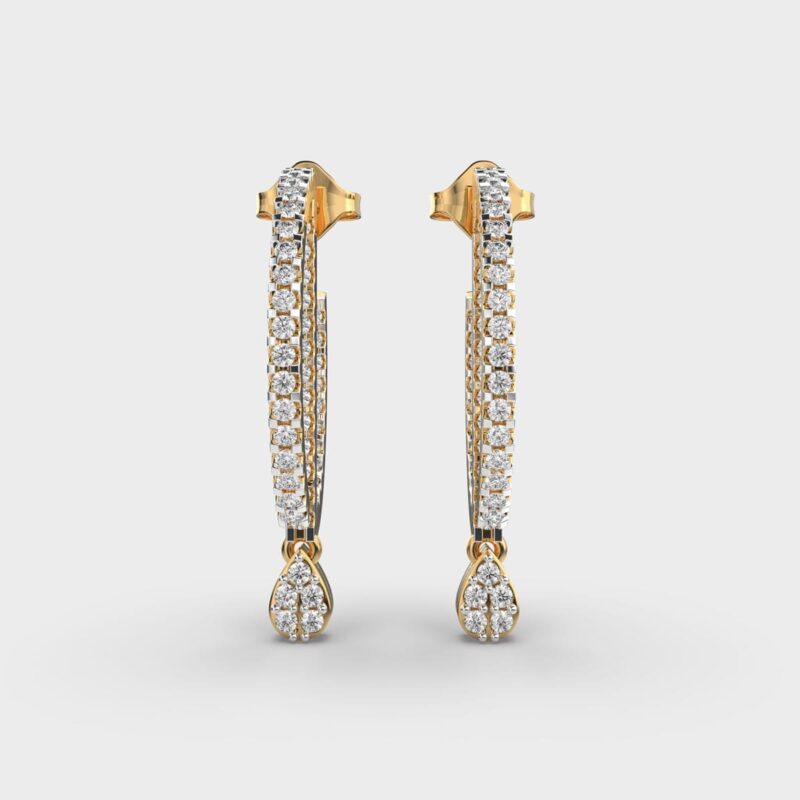
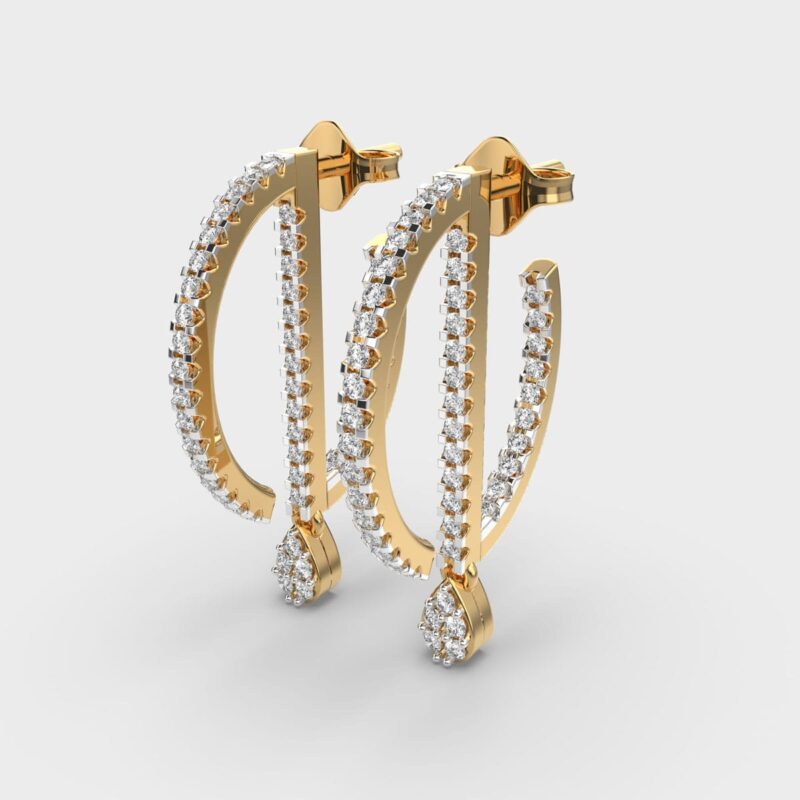
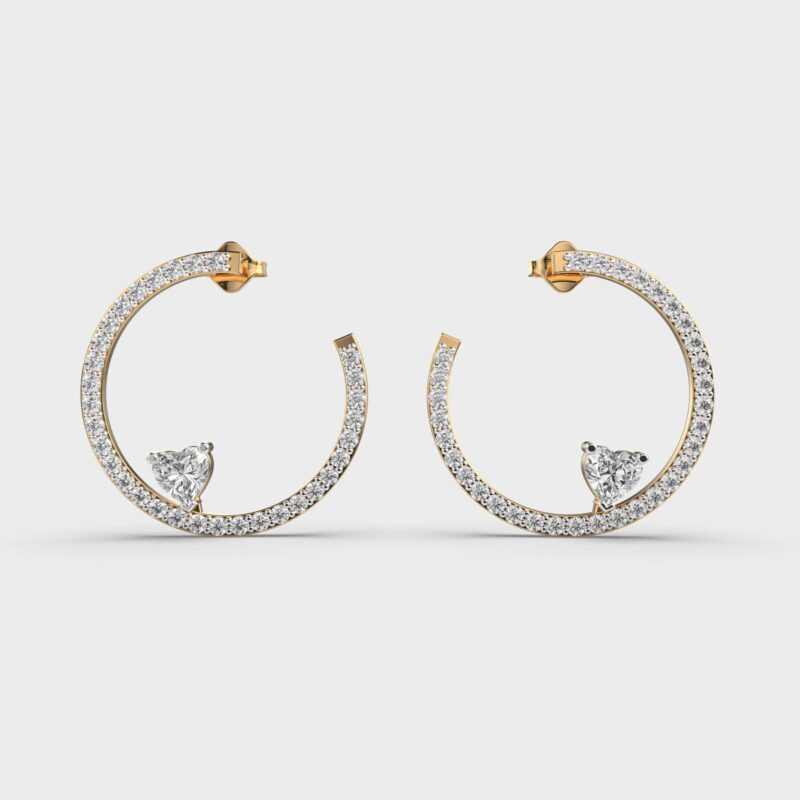
Most diamond hoops set stones along the front-facing surface only. An inside-out hoop sets stones along both the exterior and interior surfaces of the hoop track simultaneously. This means stones are visible from the front, the side, and from behind — the effect is a continuous ring of light that performs from every viewing angle including profile.
What no competitor page explains is why inside-out construction is technically more demanding than front-facing settings.
On a flat surface — an eternity band, a pavé ring shank — shared-prong spacing between adjacent stones is a consistent calculation. Every stone sits in the same geometric relationship to its neighbors. On a curved tube, that relationship changes around the circumference. As the curve increases, the inside edge of each stone’s setting compresses relative to the outside edge. A prong-height requirement that holds a stone securely at the 12 o’clock position on the hoop is geometrically different from what holds it at the 9 o’clock or 6 o’clock position, where the curve has changed the angular relationship between the stone’s girdle and the metal wall.
For inside-out settings specifically, this geometric change applies on both faces simultaneously. The inner-row stones are set against a tighter radius than the outer-row stones on the same section of tube. Getting both rows to sit visually parallel — stones at the same angle, same height above the metal, same face-up presence — despite being on different radii requires prong heights that are calibrated to each position around the hoop individually, not set uniformly.
Surat’s manufacturing facility produces these settings in-house, with the prong calibration happening at the bench against the actual tube geometry of each hoop diameter. A retailer selecting pre-made settings from a supplier catalogue is selecting a setting already built — there is no position-by-position calibration available. That’s the real difference between an inside-out hoop where the two rows look parallel under close inspection and one where they drift visibly in the final section of the curve.
Setting Types and When They Matter
Shared-Prong Pavé (Inside-Out and Front-Facing)
Shared prongs between adjacent stones — each prong secures two neighboring stones, minimizing metal between them. Maximum stone density per linear millimeter of track. Best for: high-CTW inside-out hoops, full-circle front-facing pavé tracks. The hollow-tube hoop body reduces total weight relative to visible diamond surface, which is how a 2CTW inside-out hoop in 14K gold remains comfortable for daily wear despite its visual density.
Channel Setting
Stones sit between two continuous metal walls rather than held by individual prongs. The exterior surface is smooth — no prong tips are visible or touchable. Slightly less light entry than shared-prong (walls block some pavilion light) but genuinely snag-proof. Best for: buyers who want hoop earrings for active daily wear where prong tips catching on hair or fabric is a real concern.
Bezel Setting (Front-Facing)
A metal rim wraps each stone individually. Maximum stone protection, cleanest contemporary look, the most secure individual setting. Best for: minimalist hoop designs where each stone is a distinct visual element rather than part of a continuous pavé surface.
Diameter, CTW, and How They Relate
Diameter and total carat weight are related but not the same decision. A given CTW can be distributed across a small-diameter hoop with large individual stones or a large-diameter hoop with smaller melee. What changes the visual outcome:
- Small-diameter hoops (10–16mm) with higher CTW — the stones are larger relative to the hoop circumference, which makes each individual stone more visible and the effect bolder for the size.
- Large-diameter hoops (25–40mm) with the same CTW — the same diamond weight distributed over a longer track produces a finer, more delicate pavé line. Increasing CTW at large diameter makes the line denser.
For inside-out hoops specifically: the CTW doubles the visual diamond surface area, so a 1CTW inside-out hoop has roughly the same visual presence as a 2CTW front-facing hoop of the same diameter. This is worth knowing before comparing prices across setting styles.
Primira offers custom diameter and CTW combinations — if the standard configuration doesn’t match what you have in mind, specify your requirements in the pre-production WhatsApp confirmation and the Surat team will confirm what’s achievable with the exact stone parcel before casting begins.
Stone Specifications for Hoop Earrings
All lab grown diamonds in Primira’s hoop and huggie earrings are:
- Clarity: VVS1 to VS2 — all eye-clean. Primira does not stock SI2 or below. In a pavé hoop where 20–40 individual melee stones sit side by side, any clarity inconsistency in the parcel is visible as a dull patch in the track. The VVS–VS2 floor exists partly for this reason — not just per-stone aesthetics, but parcel uniformity.
- Color: D–F colorless (primary) or G–H–I near-colorless (value tier). In a white gold or platinum setting, D–F gives the cleanest color-neutral look. In yellow gold, G–H–I reads warm rather than off-color and is genuinely a reasonable pairing for the metal tone.
- Cut: Ideal/Excellent/Very Good only — never Good or Fair. In a continuous track setting where stones can’t be individually re-examined after setting, the cut was the last accessible quality variable before production committed.
- Certification: Each lab grown diamond earring pair comes with IGI certification. In a full-pavé or inside-out hoop, the certification covers per-stone cut, color, and clarity grading across the parcel — confirmation that what went into the track is what the report says.
Moissanite Hoops
Every hoop and huggie style is also available with Primira’s hand-cut moissanite in place of lab grown diamond. Moissanite’s refractive index of 2.69 (vs 2.42 for diamond) produces more optical fire — particularly visible in a moving hoop where the stones are constantly changing their angular relationship to a light source. The hand-faceting that Surat’s cutters apply to Primira’s moissanite controls this so it reads as fire rather than the over-saturated rainbow effect common in machine-cut moissanite. Choose moissanite via the Stone Type attribute at checkout; all diameter and CTW options apply equally.
Custom Hoops
The custom order process is straightforward for hoops: diameter, CTW, setting type (inside-out, front-facing pavé, channel, bezel), metal (10K to 950 platinum), metal tone (yellow, white, rose), and stone specification (color tier, clarity). The pre-production WhatsApp confirmation — within 24 hours of your order — covers two hoop-specific details that can’t be verified from a product image: the hinge tension specification (tension-lock vs snap-fit) and whether the inside-out stone rows are parallel across the full diameter of your specific hoop size.
Reference images are accepted. The WhatsApp confirmation can match a specific design you’ve seen elsewhere, or build from scratch. Production runs 15–35 business days; certified loose stones already in inventory dispatch within 48 hours.
How to Buy Hoops Wisely: The Short Version
Four questions worth answering before you order:
- What’s this pair doing in your rotation? Huggie (daily anchor, ear stack, second piercing) or standard hoop (solo statement, evening, occasion)?
- Inside-out or front-facing? Inside-out doubles diamond surface visibility — and price — for the same CTW. Worth it if you want 360° sparkle. Front-facing is the classic, cleaner for channel and bezel styles.
- What CTW relative to diameter? Small diameter + higher CTW = bold for the size. Large diameter + lower CTW = delicate pavé line. Specify what matters to you in the confirmation.
- What closure type? For huggies: tension-lock hinge (ask specifically — not all huggies are equal here). For standard hoops: latch-back is the most secure daily-wear option.
Care and Daily Wear
The setting geometry that makes inside-out hoops beautiful creates one care requirement worth noting: both the inner and outer stone rows need cleaning. The inner row sits against the earlobe and accumulates skin oils and debris that the outer row — fully exposed — does not. A soft-bristle toothbrush, warm water, and mild soap, worked gently around both stone surfaces, is what keeps the inner row performing optically the same as the outer. For channel-set hoops, pay particular attention to the ends of the channel walls where debris accumulates inside the groove.
Huggie hinges: wipe the hinge mechanism after each wear session to clear oils that impede smooth operation. A hinge that clicks cleanly when new and starts dragging within a few weeks usually needs a thorough clean at the pivot point, not adjustment.
Store hoops separately from other jewelry — contact with harder pieces scratches gold alloy surfaces. 14K gold (our default for hoops and huggies) has the tensile strength for daily wear; platinum provides additional security if you’re particularly hard on your jewelry.
Trust, Policy, and the Practical Details
The one thing you cannot verify from a hoop product photo is hinge tension — whether the huggie closes under spring pressure or just snap-fits. This is confirmed in the pre-production WhatsApp conversation before casting begins, along with inside-out row parallelism for your specific hoop diameter. Every order ships insured from Surat to delivery confirmation. For India orders above ₹10,000, shipping is free via Blue Dart or Delhivery (2–7 business days after dispatch). International express shipping (DHL/FedEx/UPS, 5–7 business days after dispatch) is free on orders above USD $550; standard international is available otherwise.
If there’s a specification mismatch — what arrived differs from what was confirmed in the WhatsApp pre-production conversation — the 7-day return window applies from delivery date. Earrings must be unworn and in original packaging with the original IGI documentation.
The buyback program is available as an alternative to returns: buyback value calculated at invoice value minus making charges and processing fees, requiring original invoice, certification, and quality inspection..
For questions about a specific hoop diameter, CTW configuration, or custom design before you order, WhatsApp +91 9510640173 or email contact@primiraluxury.com.
FAQ
What is the difference between a huggie and a hoop earring?
A huggie is a small hoop — typically 8–14mm inner diameter — that sits flush against the earlobe and closes via an integrated click-hinge mechanism built into the earring body. It is engineered to sit against the lobe rather than hang from it, with no visible backing. A standard hoop is larger (15mm and above), hangs away from the lobe, and uses a latch-back or hinged post closure at the piercing point. All huggies are technically hoops, but the two styles serve different practical purposes: huggies for daily wear and ear stacking, standard hoops for statement and occasion wear.
How does an inside-out diamond hoop differ from a regular diamond hoop?
A regular diamond hoop sets stones along the front-facing surface only — the diamonds face outward toward the viewer. An inside-out hoop sets stones along both the exterior and interior surfaces of the hoop track, so the earring sparkles from the front, the side, and from behind. Visually, this approximately doubles the diamond presence for a given diameter. It also requires more precision in setting — stones on two different radii of the same tube section need to read as parallel, which requires position-by-position prong calibration rather than uniform spacing.
What CTW should I choose for diamond hoop earrings?
It depends on both diameter and intended use. For huggie earrings (10–14mm), 0.25–0.75CTW per pair gives a refined, close-fitting sparkle for daily wear. For medium hoops (18–25mm), 1–2CTW front-facing or 1–1.5CTW inside-out gives a clear diamond presence without feeling heavy. For large statement hoops (30mm+), 2CTW and above produces a genuinely impactful pavé line. If you’re uncertain, include your diameter preference and intended occasion in the pre-production WhatsApp confirmation — the Surat team can advise on what the parcel will look like at your chosen diameter before production starts.
Can I stack diamond hoop earrings with other earrings?
Yes — this is exactly what huggies are designed for. A pavé huggie in a second or third lobe piercing, stacked alongside diamond stud earrings in the first piercing, is the defining ear-stacking move of 2026. For stacking, diameter consistency matters: huggies at different sizes (10mm and 12mm, for example) create visual contrast intentionally. Mixing a huggie with a drop or dangler earring in the same ear is the other common configuration — one piece with movement, one anchored piece.
Are lab grown diamond hoop earrings a good gift?
Hoops are among the most universally wearable earring styles and don’t require sizing the way rings do. For gifting, the practical detail that matters is metal tone preference (yellow, white, or rose gold) and whether the recipient already wears earrings in multiple piercings — which would point toward a huggie as a second-piercing piece rather than a standalone large hoop. The pre-production WhatsApp confirmation means any specification can be adjusted before production begins, so if you’re unsure of a detail, the team can clarify before anything is made.
Do lab grown diamonds in hoop earrings look the same as mined diamonds?
Lab grown diamonds have the same optical, physical, and chemical properties as mined diamonds — the same crystal structure, the same refractive index (2.42), and the same hardness (10 on the Mohs scale). In a finished hoop or huggie earring, there is no visual distinction. IGI grades lab grown diamonds on the same 4Cs scale it uses for mined diamonds, and the certification covers the same cut, color, clarity, and carat fields. The report number is laser-inscribed on each stone’s girdle and verifiable at igi.org.
Explore the Earring Collection
Diamond stud earrings — the other daily-wear anchor in a curated ear look.
Drop and dangler earrings — movement and length for occasion and festive wear.
The full earring collection — all styles in one place.










 1-to-1 Custom Design
 Craft Your Vision
 HD video Preview
 Fully Customizable
 Choose Metal Tone:
 Handcrafted in Solid 10K · 14K · 18K
 Select Your Stone Type:
  Award winning
  Hallmarked &
  Personalized Care &
  Design Any Piece

 Chat on WhatsApp