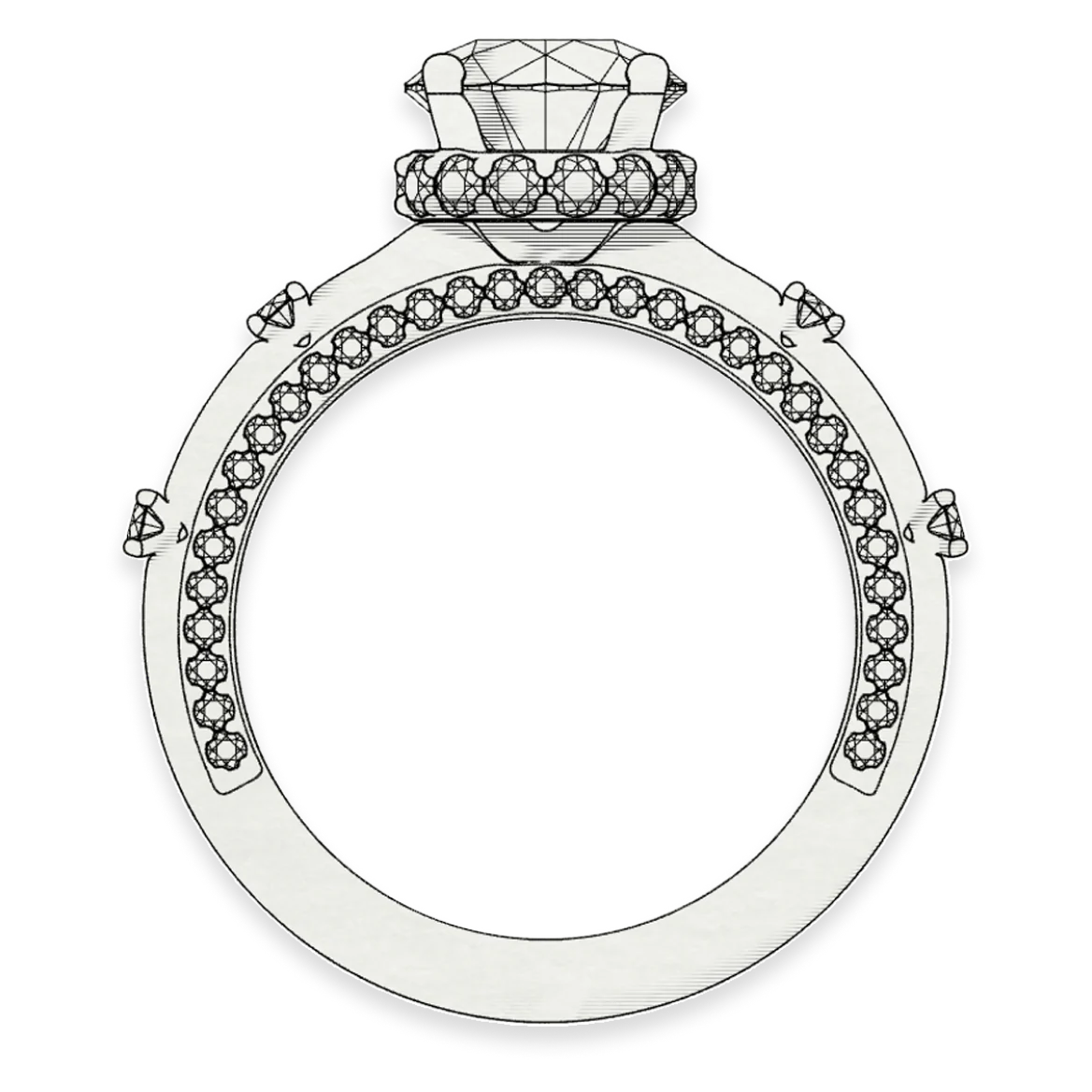
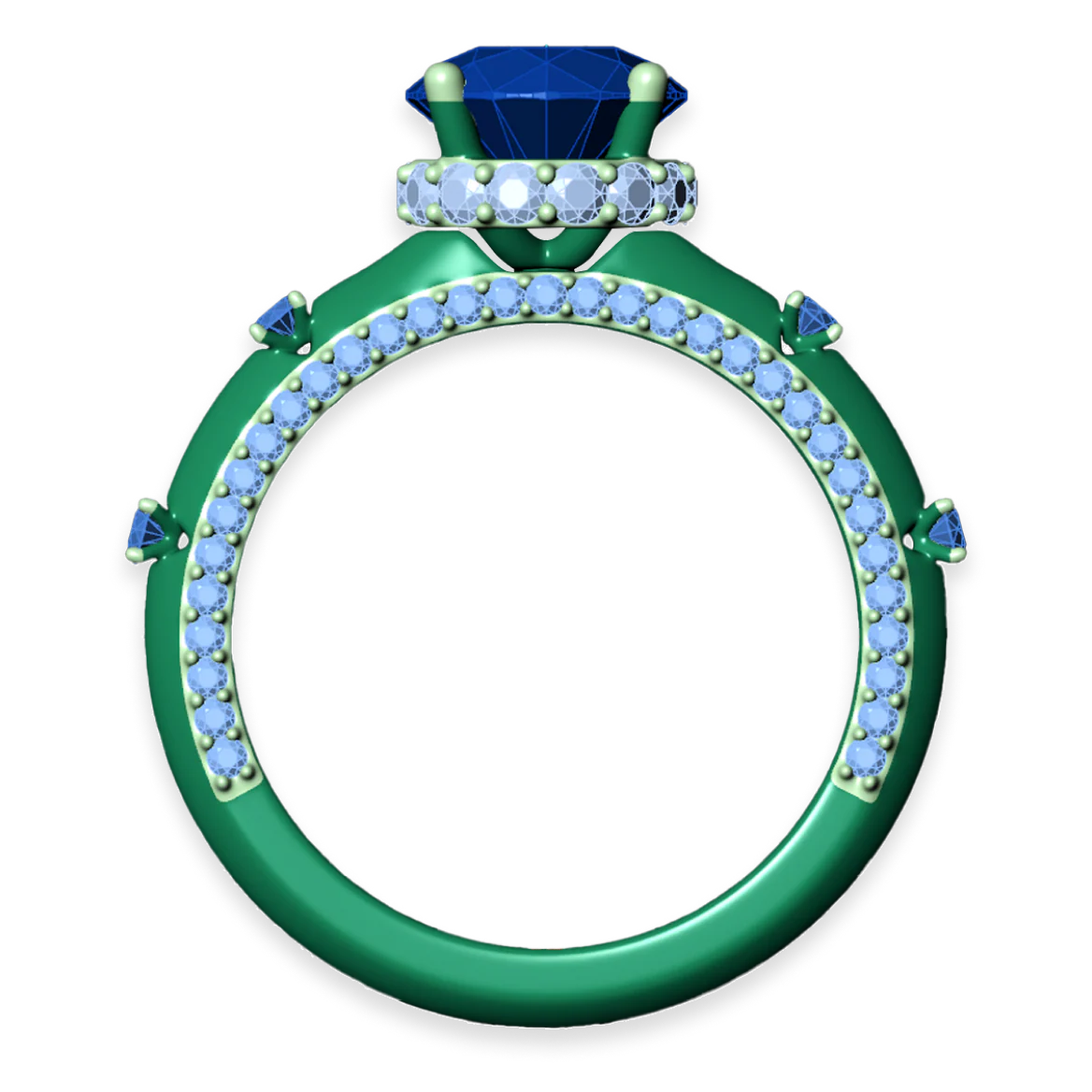
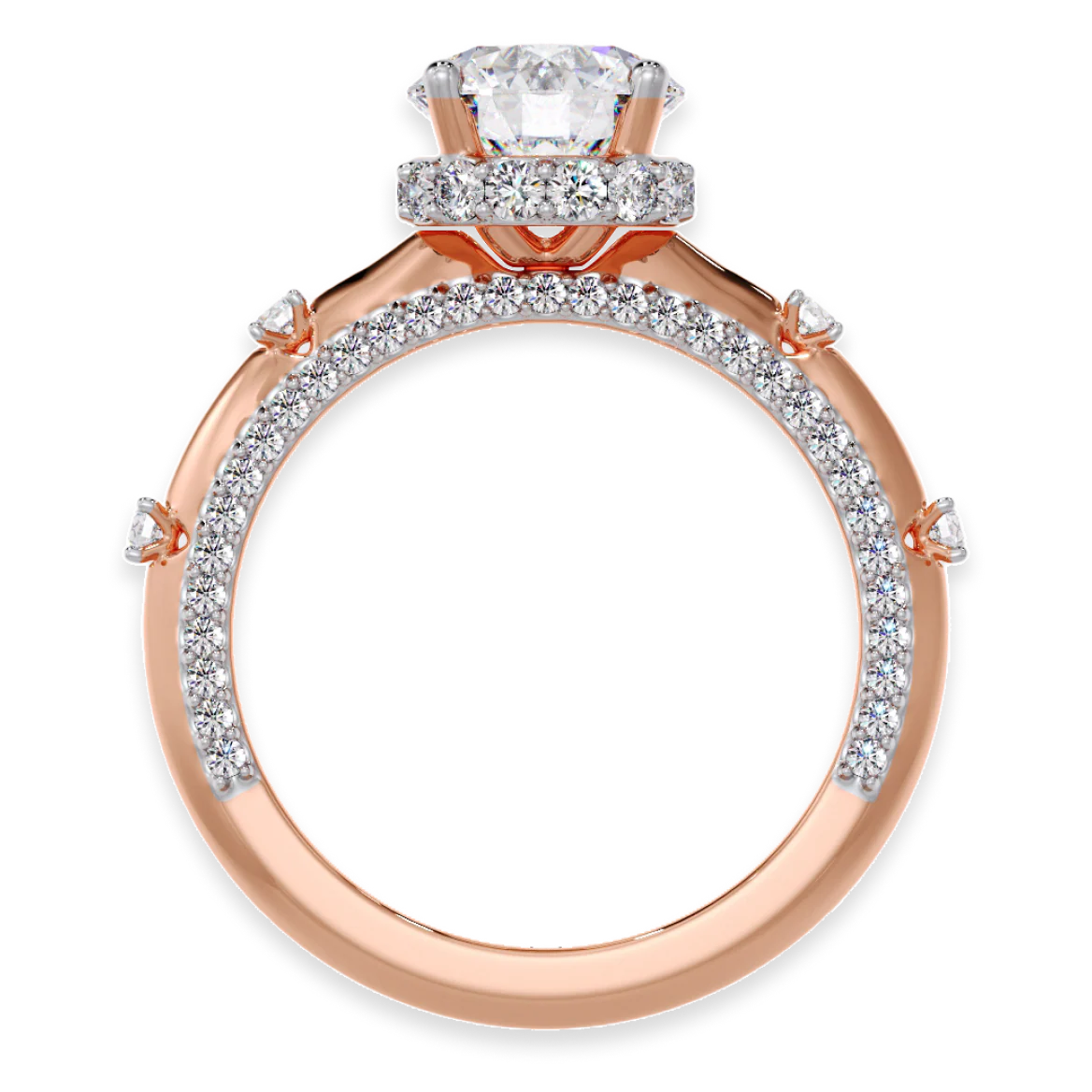
Minimalist Lab Grown Diamond Rings — Daily Wear, Surat-Made
The Precision Paradox of Minimalist Design
A bold cocktail ring can absorb a slightly imprecise stone seat or a bezel rim that’s 0.2mm too high. The halo draws the eye. The metalwork fills the frame. There’s room for variation that no one will ever see.
A minimalist ring has none of that. One stone, one setting, a band that may be 1.5mm wide. Every dimension is visible. A bezel rim cut 0.2mm too tall sits above the stone’s crown and shadows the facets that should be catching light. A shank with the wrong cross-section for the wearer’s hand geometry presses against an adjacent finger every time the hand closes. A comfort-fit radius that isn’t calibrated to actual finger width starts to feel like the wrong ring within weeks of daily wear.
This is the part of minimalist lab grown diamond rings that most product pages skip: the aesthetic demands more manufacturing precision, not less. The design is unforgiving by definition. What that means for a buyer ordering remotely is that the specifications confirmed before production — shank profile, setting height, stone dimensions — matter more here than on almost any other ring format.
Primira sources and facets lab grown diamonds in Surat, where 90% of the world’s rough diamonds are processed. Every minimalist ring in this collection is set at the same bench that cut the stone. The rim height, the seat depth, the shank cross-section — each is calibrated to the actual measured dimensions of the specific stone, not to a generic template.
What Makes a Ring Minimalist — and What It Requires
Minimalist doesn’t mean a ring with less thought behind it. It means a ring designed around a single focal point, with every other element existing to support that point rather than compete with it.
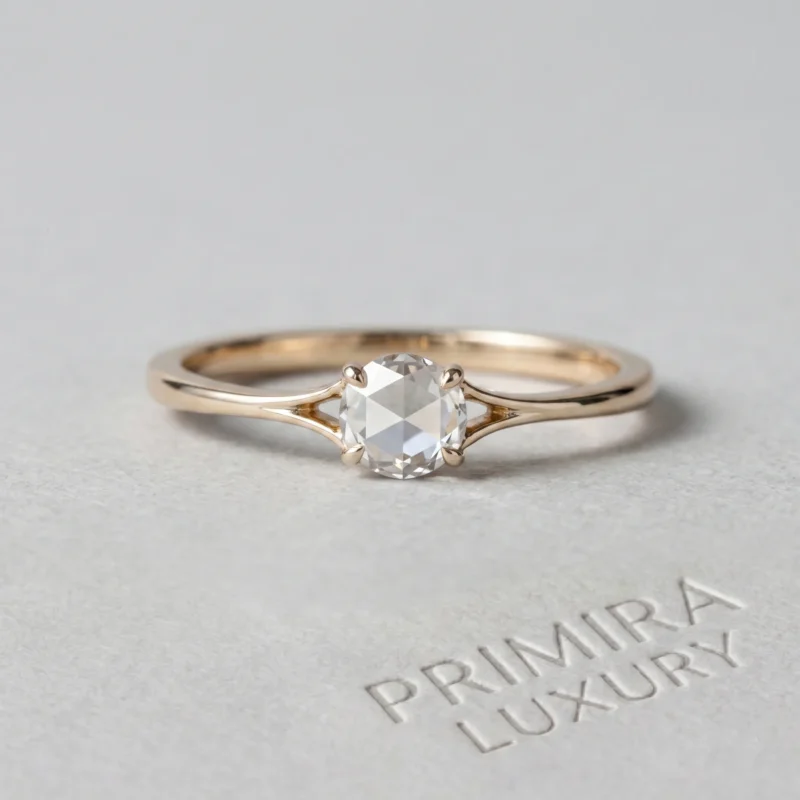
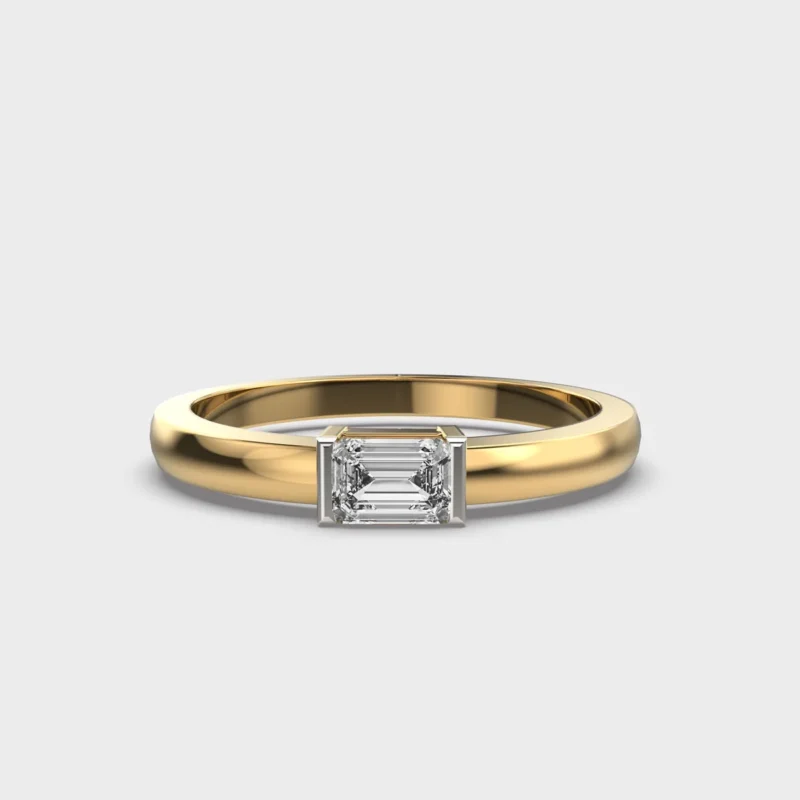
In practical terms: a single lab grown diamond, a band between 1.5mm and 2.0mm wide, a setting with a low or flush profile, and no accent stones or halo geometry adding visual mass. The stone and the metal are all that’s there — which is exactly what makes the manufacturing decisions so consequential.
Shank Cross-Section: The Specification Most Buyers Don’t Know to Ask About
A band described as “1.8mm wide” tells you almost nothing about how it will wear. What matters as much as width is cross-section profile — the shape of the band when seen from the end.
Knife-edge: two flat faces meeting at a ridge along the top of the shank. Creates the visual impression of a band even thinner than it is. Sits cleanly against adjacent fingers without bulk. The ridge contact point on the finger surface is minimal, which some wearers find more comfortable over long wear periods.
Flat (or slightly domed): even thickness across the full width. The most durable cross-section at thin gauges because the metal is uniform — no thinning at a ridge point. Sits flush against adjacent fingers, which increases surface contact. Can feel slightly wider than it is.
Comfort-fit (rounded interior): the inside of the shank has a convex curve rather than a flat or square interior. At 1.5–2.0mm, the benefit is subtle but real — it reduces the hard edge that a flat inner shank presents to the finger over hours of wear. Comfort-fit at thin gauges requires precise radius calibration; too aggressive a curve on a narrow band removes metal and weakens the shank.
At Primira, shank profile is a confirmed production specification, not a detail that defaults to whatever the template dictates. Confirm it via WhatsApp before production begins.
Setting Options: What Each One Actually Does
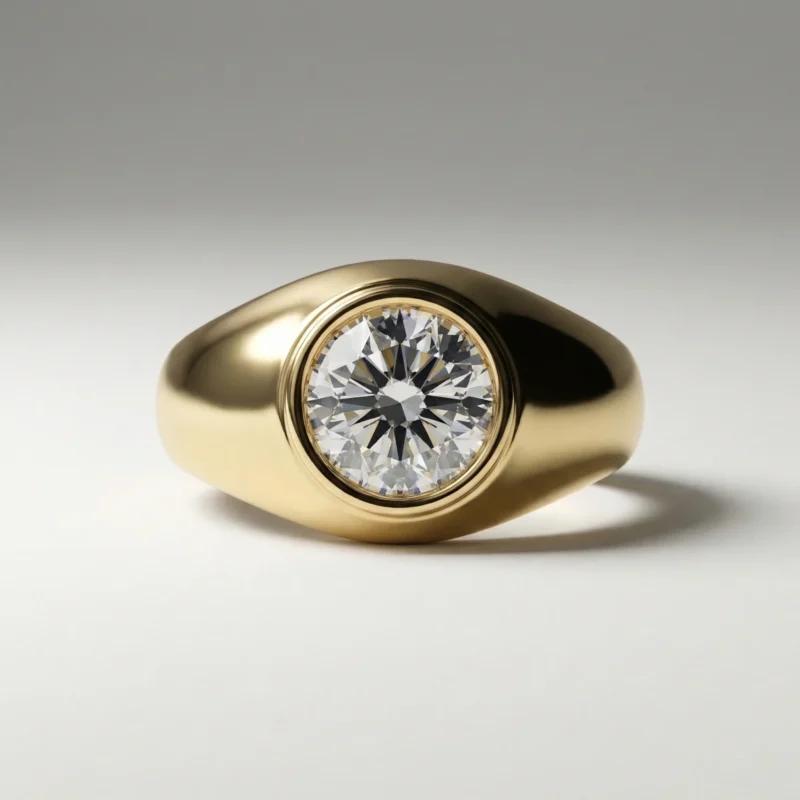
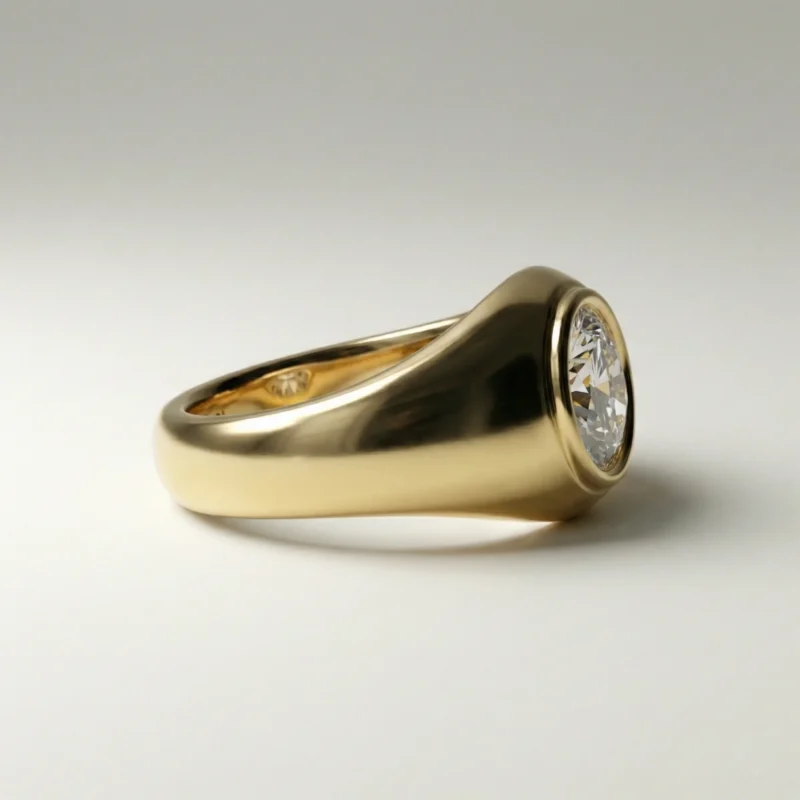
Full bezel wraps a continuous metal rim around the entire stone perimeter. The most secure setting available — no prong tips exposed, no snagging, the stone protected on every axis. For minimalist rings specifically, it’s also the most architecturally precise: a clean geometric outline that changes character depending on whether the rim is polished to match the shank or brushed to contrast it. The bezel requires rim height calibrated within approximately 0.1mm of the stone’s actual girdle thickness — too high shades the crown facets and kills the stone’s light output; too low fails to grip the girdle securely.
Partial bezel (semi-bezel) covers the east and west ends of the stone while leaving the north and south faces open. More light enters from the open sides, making it brighter than a full bezel while still protecting the most vulnerable parts of the stone’s perimeter. Well-suited to oval and elongated shapes, where the open north-south face allows the stone’s length to read fully.
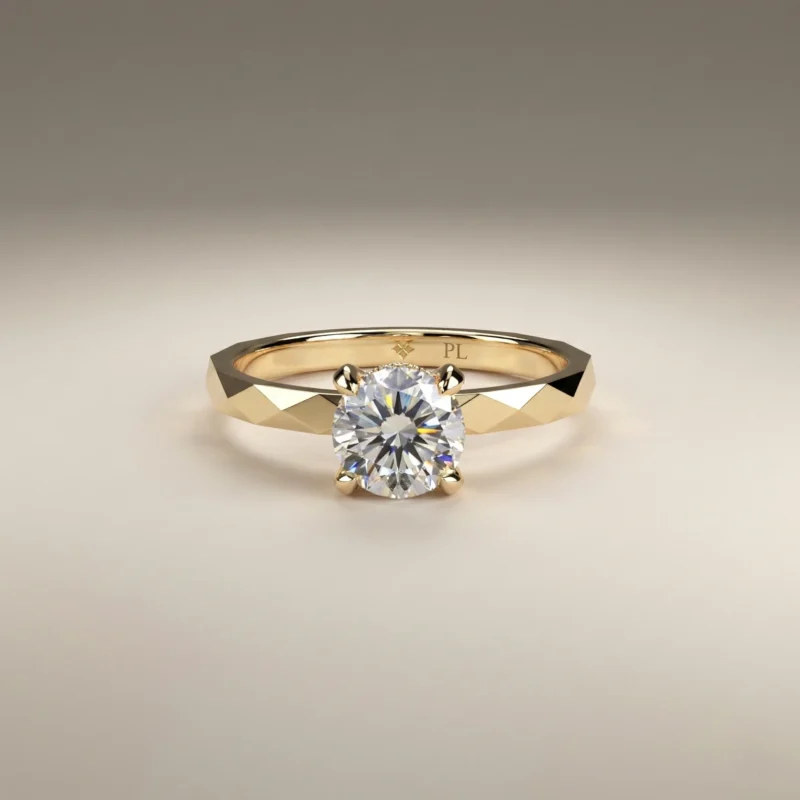
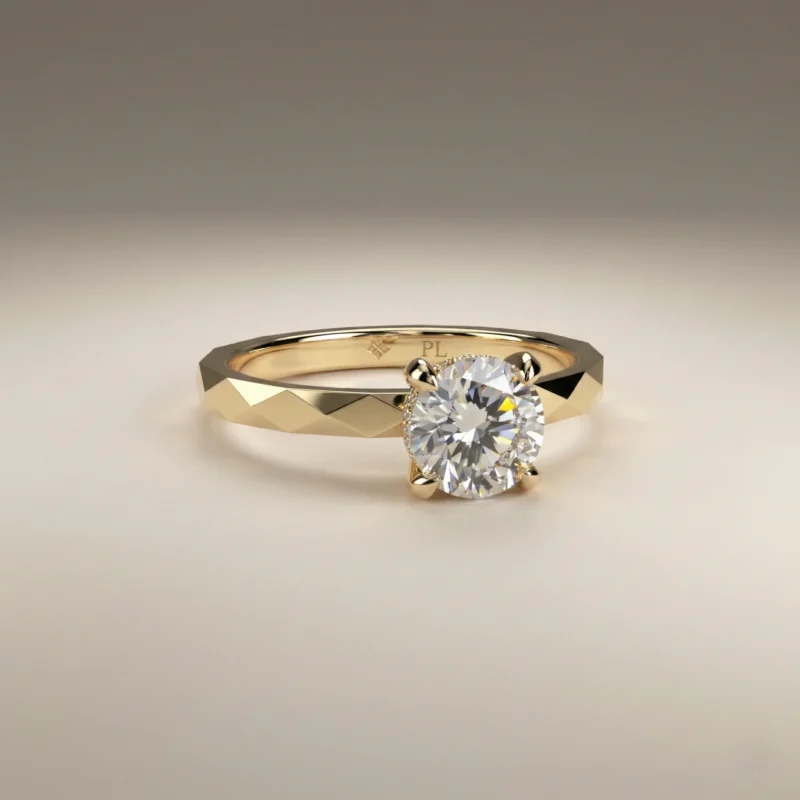
Four-prong (at thin-band scale, usually 0.8–1.0mm claw thickness) maximizes light into the stone from all directions. Holds the stone at the minimum number of contact points. At thin-band scale, the four prongs also become part of the visual statement — they’re not hidden, and a clean, symmetrical claw profile at this size requires precise finishing work. The trade-off against bezel: prong tips can catch occasionally, and the setting requires checking every 12–18 months to confirm prong integrity during daily wear.
Flush/burnish — the stone is set into a drilled seat and finished level with the metal surface. The entire ring reads as a solid metal band with a point of light in it. Maximum protection. A very particular aesthetic — more architectural than jewellery-traditional. Well-suited to a round or a square-cut lab grown diamond at 0.10–0.25ct, where the effect is a flash of light rather than a featured stone.
Tension — the stone is held by the pressure of two opposed metal ends, appearing to float in the opening of the band. Visually striking: all diamond, no visible support structure. Engineering requirement: metal hardness must be calculated against stone diameter to hold securely without over-stressing the band at the contact points. Platinum and 18K gold handle this reliably; sterling silver is not suitable for tension settings. Round brilliant and oval lab grown diamonds work best — shapes with pointed ends (pear, marquise) carry impact risk at the exposed tips.
Stone Specifications for a Minimalist Ring
The aesthetic logic of minimalist design runs directly into stone quality: when the setting adds nothing and the band adds nothing, the stone is entirely accountable for what the ring does optically.
Cut matters more here than in a halo or cluster format. In a halo ring, the melee adds light and visual mass around the centre stone, which compensates for a weaker cut grade on the centre. In a minimalist solitaire ring, there is no compensation. Primira stocks only Ideal and Excellent cut lab grown diamonds — the same cut grades sold by international retailers at significantly higher prices. On a minimalist ring, this isn’t an upsell; it’s the structural reason the ring works.
Colour in the D–F range reads as optically colourless. G–H–I colour in a bezel setting, particularly a yellow gold bezel, can show warmth that some buyers find flattering and others find unexpected — worth specifying clearly at order confirmation. In a white gold or platinum setting, G–H–I is essentially invisible to the naked eye at typical wearing distance.
Clarity in the VVS1–VS2 range is standard across Primira’s stock. Eye-clean clarity at this range means a minimalist ring’s stone will look clean to anyone looking at it — no inclusions visible without magnification. SI2 and below are not stocked.
Carat weight and face-up diameter interact differently on a thin band than on a wider shank. A 0.50ct round brilliant has a face-up diameter of approximately 5.1mm. On a 1.6mm band, it reads as the dominant element of the ring — which is the correct minimalist proportion. A 1.0ct round (approximately 6.5mm face-up) on the same 1.6mm band is a genuinely different ring — more presence, less restraint. Neither is wrong. The proportion decision is worth making consciously rather than defaulting to a carat size and discovering the visual balance on delivery.
Standard carat range: 0.25ct through 3ct for minimalist formats. Custom sizes on order.
Metal Options for Minimalist Rings
At thin gauges, metal selection has structural implications that go beyond tone preference.
14K gold (585) is the default recommendation for minimalist rings at 1.5–2.0mm. At 58.5% pure gold with a hardened alloy remainder, it holds structural integrity at thin gauge without becoming brittle. Available in yellow, white (rhodium-plated), and rose tones.
18K gold (750) at 75% pure gold is softer than 14K and more prone to surface marking at thin gauge under daily wear. Correct choice when the colour depth of 18K yellow is the specific aesthetic, or when a higher gold content tier matters to the buyer. Slightly heavier than 14K at equivalent dimensions.
950 Platinum is the strongest choice for long-term minimalist ring wear. At 95% elemental platinum, it doesn’t plate (no rhodium top-coat over a different metal — it’s platinum the whole way through), doesn’t tarnish, and develops a patina over years of wear that many buyers prefer to a maintained polish. The trade-off: platinum is denser than gold, so a platinum minimalist ring will feel slightly heavier than a gold ring of identical dimensions — still light, but perceptibly different.
925 Sterling Silver is the entry option. Clean high-polish reflective surface, lightweight, and lower cost. Requires rhodium plating maintenance over years of daily wear to prevent tarnish.
All metal tones available in high polish (default), brushed, or matte finish.
How a Minimalist Ring Wears Alongside Other Rings
One of the practical advantages of a minimalist format is stacking compatibility. The slim profile and low setting height mean the ring can sit cleanly alongside a plain wedding band, an eternity band, or a second thin pavé band without crowding.
For buyers who know they’ll stack: a flat inner shank (rather than comfort-fit) sits more flush against an adjacent band, which prevents the slight gap that a rounded comfort-fit interior can create between rings. Confirm this at order stage if stacking is the plan.
For comparison with the wedding bands stackable collection — those are specifically engineered for multi-ring compatibility, with crown-arch geometry designed to sit against an engagement ring without height conflict. A standalone minimalist fashion ring and a stackable wedding band are solving different engineering problems.
For buyers considering whether a minimalist daily-wear ring is what they want, or whether a lab grown diamond solitaire engagement ring is the right frame — the two are distinct: an engagement ring solitaire typically uses a higher-set mounting (cathedral or standard basket) to maximise stone visibility, while a daily-wear minimalist ring prioritises a lower, flush profile for comfort and snag prevention. The design brief is different even when the stone and metal are identical.
Custom Minimalist Rings
The minimalist format is one of the most practical for custom orders precisely because there are fewer variables to coordinate: the most consequential decisions are shank profile, setting type, stone dimensions, and metal tier.
What’s genuinely available to customise at Primira:
Shank width (1.2mm through 3.0mm for minimalist formats), shank cross-section (knife-edge, flat, comfort-fit), setting type (full bezel, partial bezel, four-prong, flush, tension), stone shape and carat, metal tier and tone, finish (high polish, brushed, matte, hammered, two-tone).
What’s unique to this format: the shank profile can be specified with the stone in hand. Because Primira cuts and sets stones at the same Surat facility, the bezel height and seat depth are calibrated to the actual girdle thickness and pavilion depth of the specific lab grown diamond — not to an average or a template. A 0.75ct oval with a 5.0×7.0mm face-up has different pavilion geometry than a 0.75ct oval with a 5.2×6.8mm face-up, and the setting is made to match.
Reference images accepted. Custom orders confirmed via WhatsApp before any production begins.
Care for a Minimalist Ring
Thin shanks and low-profile settings have two care considerations that don’t apply to heavier ring formats.
Shank integrity over years of wear. At 1.5–2.0mm width, the shank is thinner than most rings and accumulates micro-abrasion from daily contact more visibly than a wide band. This is a surface phenomenon — the metal isn’t weakening structurally — but high-polish finish shows it earlier than brushed or matte. Annual check at a jeweller takes two minutes and catches any thinning at the base of the shank (the point of maximum daily friction) before it becomes a problem.
Bezel contact. A bezel-set minimalist ring is the most protected setting available — but the continuous metal rim is itself subject to surface abrasion from daily contact with hard surfaces. Platinum bezels handle this more gracefully than gold, developing a surface patina rather than showing directional scratches. For gold bezels: occasional re-polishing at a bench returns them to original finish. This is a one-time service, not a recurring cost.
Cleaning. Minimalist settings collect less debris than cluster or pavé formats, but a bezel setting accumulates skin oils between the rim and the stone’s girdle over time. Warm water and a soft brush under the stone quarterly is sufficient. Ultrasonic cleaning is suitable for bezel and prong settings with lab grown diamonds but should be avoided with tension settings, where ultrasonic vibration can gradually work the stone loose from its pressure-fit.
Frequently Asked Questions
Are minimalist diamond rings lower quality than elaborate styles?
No — and the relationship actually runs the other way. A bezel or four-prong minimalist setting has no accent stones or halo geometry to compensate for a weaker cut grade on the centre stone. The stone is entirely accountable for the ring’s optical output, which is why cut quality matters more on a minimalist ring than on almost any other format. Primira stocks only Ideal and Excellent cut lab grown diamonds, with clarity in the VVS1–VS2 range throughout.
What band width is right for a minimalist ring?
1.5–2.0mm is the standard range for minimalist daily-wear rings. Within that range, 1.6–1.8mm balances visual delicacy against structural durability for 14K gold at daily-wear use. Below 1.5mm, the band is light but structurally marginal for a ring that will be worn consistently. At 2.0mm, the ring begins to transition toward a presence that some buyers will find is no longer minimalist. What interacts with width is the shank cross-section — a knife-edge cross-section at 1.8mm reads visually thinner than a flat band at the same width, because only the ridge makes contact with the eye. This is worth specifying at order confirmation.
Which setting is best for a minimalist diamond ring?
Depends on what the ring needs to do. A full bezel is the most secure and lowest-maintenance option — no prongs to check, no snagging, the stone protected from all sides. A four-prong at thin-band scale lets the most light into the stone and has a clean architectural presence. A tension setting is the most visually dramatic — the stone appears to float — but requires the right stone shape (round or oval) and a strong metal (platinum or 18K gold). Flush settings suit buyers who want a flash-of-light rather than a featured stone. There is no single correct answer; the trade-offs are real in each direction.
Can I wear a minimalist diamond ring every day?
Yes — this is the format designed for daily wear. Low-profile and bezel/flush settings have no protruding prong tips to snag. The ring’s slim profile sits under most hand movements without catching. The caveat at thin gauge: the shank accumulates surface abrasion from daily contact more visibly than a wide band, and an annual check at a jeweller is good practice. A platinum shank handles daily contact better than gold at thin gauge, developing a surface patina rather than directional scratching.
What carat size looks right on a thin band?
A 0.50ct round brilliant (approximately 5.1mm face-up) is the most common starting point for a 1.5–1.8mm band — the stone is clearly present without overwhelming the slim format. A 0.75ct (approximately 5.8mm face-up) reads as more substantial. A 1.0ct (approximately 6.5mm face-up) shifts the ring from quiet to considered. Elongated shapes — oval, pear, emerald-cut lab grown diamonds — read as larger face-up than round brilliants at the same carat weight, which allows for a smaller carat weight to achieve the same visual presence on a thin band. Confirm the proportion at order stage; Primira’s pre-production WhatsApp confirmation covers stone face-up dimensions alongside all other specifications.
Can a minimalist ring stack with a wedding band?
Yes, and this is one of the practical arguments for the format. A low-profile minimalist ring leaves clearance for a plain band or a thin pavé band alongside it without height conflict. The stacking consideration that matters: specify a flat inner shank (rather than comfort-fit) if the rings will sit directly against each other — the flat profile eliminates the slight gap a rounded interior can create between adjacent bands. If the plan is to stack a minimalist fashion ring with a dedicated stackable wedding band, see the lab grown diamond stackable wedding bands collection — those are engineered specifically for multi-ring compatibility.
Ordering and What Happens Next
Every minimalist ring order from Primira follows the same pre-production confirmation sequence: within 24 hours of checkout, the Surat team contacts via WhatsApp and email to confirm the specifications that make the difference between a minimalist ring that works and one that doesn’t — shank profile, setting type, bezel height, stone dimensions, comfort-fit radius if applicable, metal tier, finish, and ring size.
This step exists because these variables aren’t visible in a product photograph. A bezel that looks identical in two product images may be calibrated to different rim heights. The pre-production confirmation is where they become explicit specifications that production is built to.
Production: 15–35 business days from confirmed specifications. Certified lab grown diamonds already in inventory dispatch within 48 hours of confirmation.
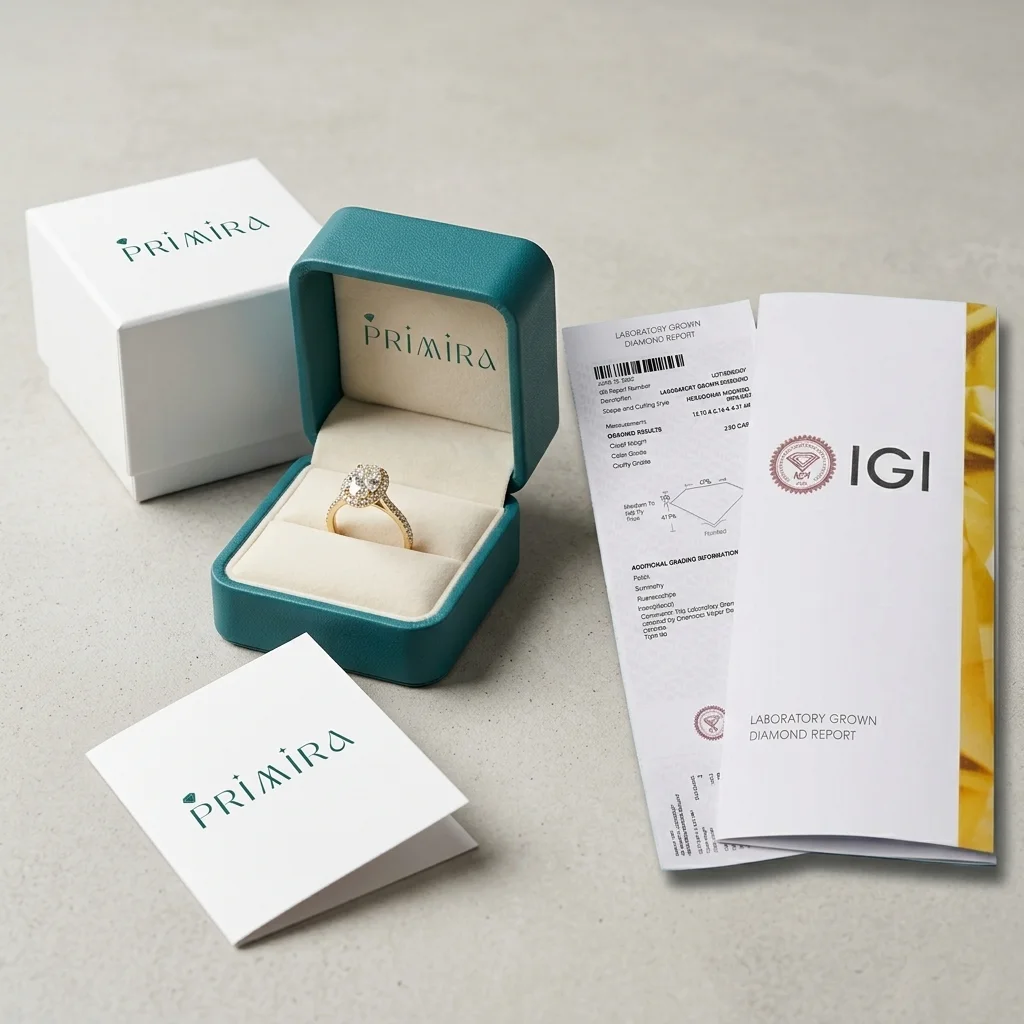
Every stone in Primira’s minimalist ring collection carries IGI certification. For a minimalist format specifically — where the stone is unshielded by accent geometry and the IGI cut grade is the only independent verification that the ring’s optical performance matches what was ordered — the girdle laser inscription (report number readable at igi.org) is worth knowing about before the ring ships.
Every order ships insured from Surat to delivery confirmation. India orders above ₹10,000 ship free; international express shipping is free on orders above USD $550. Returns accepted within 7 days where the piece delivered is materially different from confirmed specifications. The buyback programme is available for value recovery — buyback value calculated at invoice value minus making charges at prevailing gold rates.
For custom orders — non-standard shank width, a specific stone shape or carat, tension settings requiring precise metal-to-stone matching — WhatsApp +91 9510640173 before placing an order. CAD design confirmation is available for any custom minimalist ring specification.








 1-to-1 Custom Design
 Craft Your Vision
 HD video Preview
 Fully Customizable
 Choose Metal Tone:
 Handcrafted in Solid 10K · 14K · 18K
 Select Your Stone Type:
  Award winning
  Hallmarked &
  Personalized Care &
  Design Any Piece
 Chat on WhatsApp