
Primira Luxury Blog
“Jewelry is more than an accessory; it’s a timeless tale waiting to be told.”
“Like a well-crafted gem, true beauty comes from within. Let your jewelry amplify it.”


Showing all 3 results
- ₹19,042 – ₹95,718Price range: ₹19,042 through ₹95,718
- ₹13,550 – ₹70,008Price range: ₹13,550 through ₹70,008
- ₹21,479 – ₹115,566Price range: ₹21,479 through ₹115,566




Showing all 3 results
Discover Your Perfect Price
Filter by Stone Type and Metal to view accurate, variation-based pricing
Transparent, personalized, and effortless - explore designs that match your style, metal, and budget.
- Tip: Choose one stone type and one metal type to see your exact price.
- If prices seem off, just uncheck and re-apply your filters – the page will refresh with accurate pricing.
 1-to-1 Custom Design
Experience
 Craft Your Vision
Today with a 10% Starte
 HD video Preview
Before It Ships
 Fully Customizable
- Stone, Metal & Budget
 Choose Metal Tone:
Yellow, White or Rose Gold
 Handcrafted in Solid 10K · 14K · 18K
Gold, 925 Silver or 950 Platinum
 Select Your Stone Type:
 Lab-Grown Diamond or Moissanite
 Award winning
 craftmanship and detailing
 Hallmarked &
 Certified (IGI / SGL)
 Personalized Care &
 Expert Support
 Design Any Piece
Within Your Budget
1-to-1 Custom DesignExperience
Craft Your VisionToday with a 10% Starte
HD video PreviewBefore It Ships
Fully Customizable- Stone, Metal & Budget
Choose Metal Tone:Yellow, White or Rose Gold
Handcrafted in Solid 10K · 14K · 18KGold, 925 Silver or 950 Platinum
Select Your Stone Type: Lab-Grown Diamond or Moissanite
Award winning craftmanship and detailing
Hallmarked & Certified (IGI / SGL)
Personalized Care & Expert Support
Design Any PieceWithin Your Budget

Primira's
Real Reviews From Real Customers
Lifetime
Warranty
100% Money
Back Guarantee
Easy
Customization
7 Days
Return
14 Days
Exchange
Insured
shipping
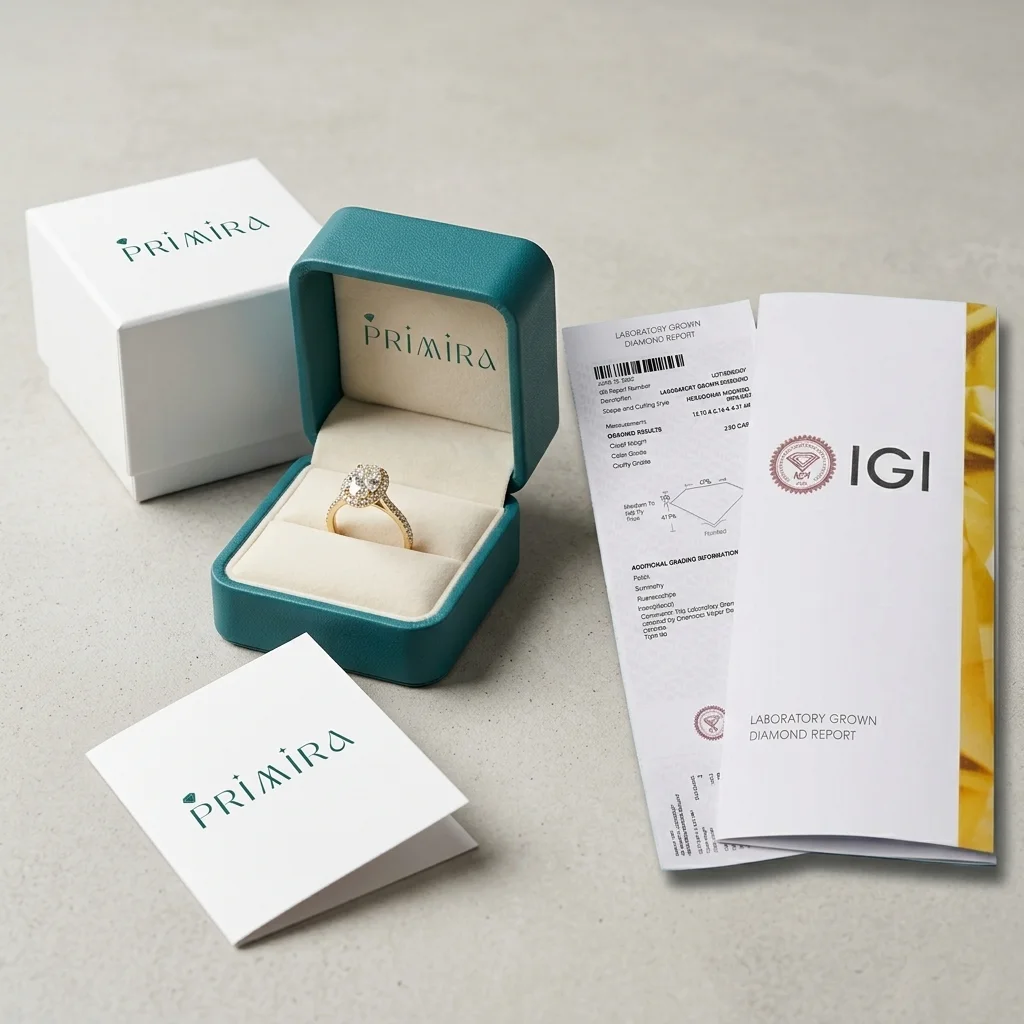
sustainable, beautiful packaging
Give your precious pieces a home they deserve with our stylish, soft-lined jewelry boxes made for effortless organization.
Read Our Article Behind Every Collection
Each design at Primira Luxury is handcrafted with precision, purpose, and emotion. From the first sketch to the final polish, our artisans turn your vision into a piece that feels personal, ethical, and timeless.
Read More
Religious Lab Grown Diamond Pendants — Om, Ganesh, Cross & More
A religious pendant carries something that a fashion pendant doesn’t have to: weight. The symbol matters before the diamond does — which means what you’re really choosing is whether the craft behind the piece is equal to the meaning it holds.
These lab grown diamond religious pendants are cut and set at our Surat manufacturing facility, where each symbol — Om, Ganesh, cross, crescent, star, and others on custom order — is approached as a specific cutting problem, not a design option selected from a catalogue.
Why the Symbol Itself Is a Lapidary Decision
Most religious pendant collections treat the symbol as a finished mold and the diamond as a fill. That’s how you get generic pieces where an Om loses its compound curve proportion, or a Ganesha silhouette reads as an indistinct figure at pendant scale.
Cutting a religious symbol in lab grown diamond is different from cutting a geometric shape. Each symbol carries proportional traditions — ratios between elements that determine whether the symbol reads as itself or as an approximation.
Om: The compound ligature connecting the main body, the lower curve, and the curved arc above it narrows significantly at the joining stroke — approximately 0.8–1.2mm at the junction. At that width, the choice between a channel wall, a micro-pavé run, or a prong cluster is a lapidary bench decision, not a catalogue specification. The curved upper arc of the Om also creates concave sections that require careful prong placement to avoid snagging against the body.
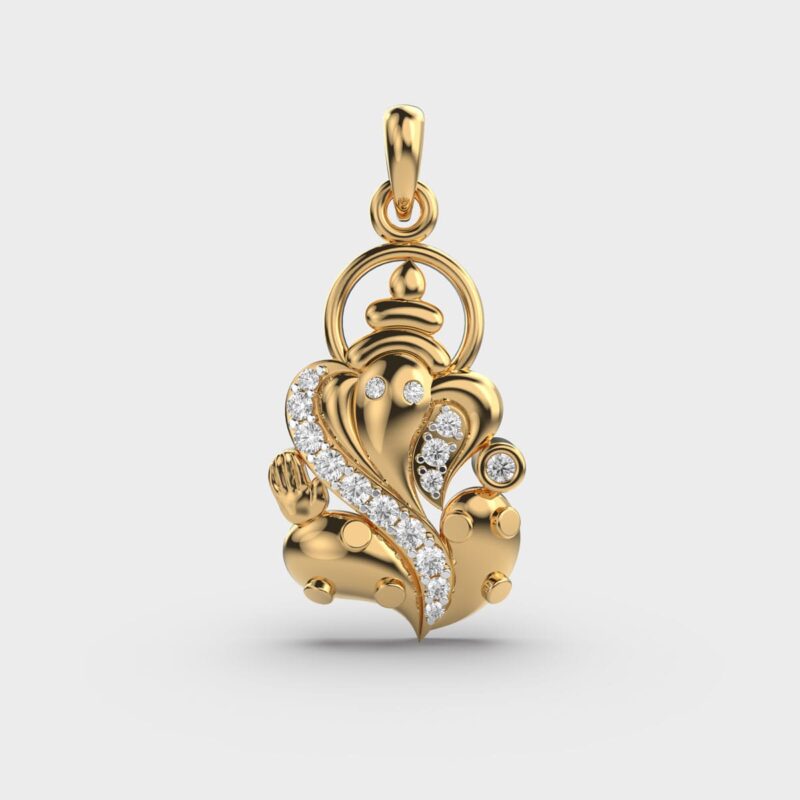
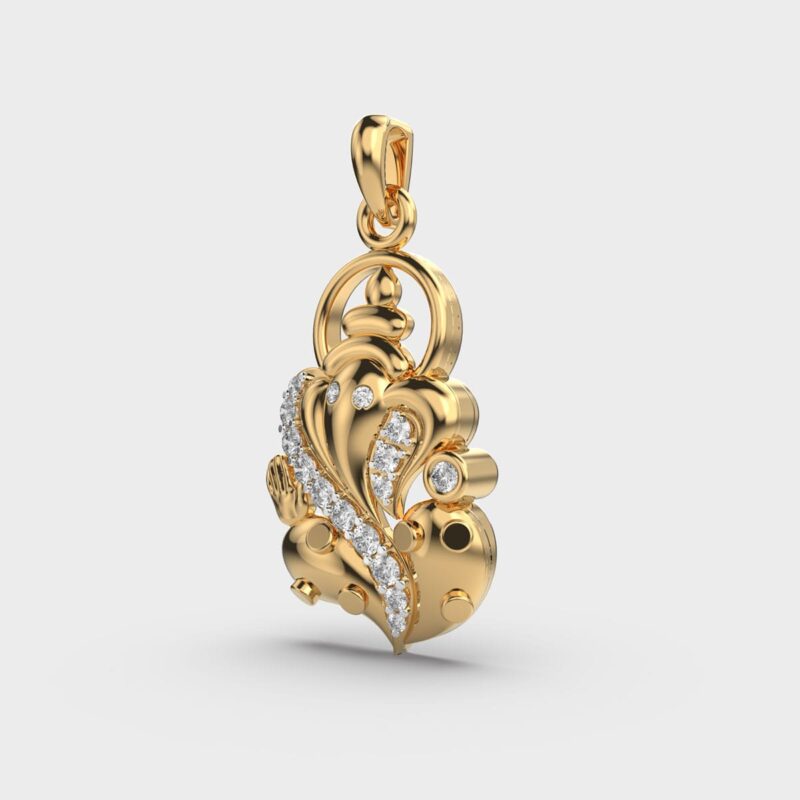
Ganesha: A figurative Ganesha silhouette in diamond requires perimeter channel decisions at every concave transition — the trunk’s inner curve, the space between the ears and the crown, the join between body and base. If stone sizing is miscalibrated at these curves, the perimeter either collapses visually or shows gaps. Our craftsmen work from reference images and confirm the proportional decisions — trunk length relative to body width, crown height, stance — before cutting begins.
Cross: Latin, Greek, and Orthodox cross conventions differ at the arm-ratio — Latin cross arms are shorter relative to the vertical shaft; Greek cross arms are equal; Orthodox crosses carry an angled lower crossbeam. The intersection-setting approach changes based on which convention the buyer wants, because the centre zone geometry is different in each case. We confirm the cross type and arm ratio via WhatsApp before production.
Crescent (Hilal): The concave inner curve of the crescent creates a prong-placement zone where stones would ordinarily crowd or cant inward. The solution is calibrated micro-pavé spacing on the inner arc with smaller melee, matched to the outer arc’s standard spacing — two different stone size tiers in one continuous shape.
Star of David: The six-point geometry creates re-entrant angles at each inner vertex that require precise bezel or channel walls to hold the stone line through the transition without breaking visual continuity.
Custom symbols — Trishul, Khanda, Hamsa/Hand of Fatima, Lotus, and others — are available on order. Describe the symbol and share a reference image via WhatsApp; our lapidary team will confirm the cutting approach before production begins.
The Lab Grown Diamond Inside a Sacred Piece
A question that comes up directly with religious jewelry: does a lab grown diamond carry the same weight as a mined stone in a piece that’s meant to be sacred?
The answer depends on what “weight” means here. Lab grown diamonds have the same optical, physical, and chemical properties as mined diamonds — identical carbon crystal structure, the same refractive index, the same IGI grading criteria. The IGI report number is laser-inscribed on the girdle of every certified stone, verifiable at igi.org. The diamond inside your pendant is, by every measurable standard, a diamond.
What lab grown changes is the supply chain, not the stone. The economic story — mining, trading, margin — is replaced by a manufacturing and cutting story. For many buyers choosing a religious pendant, that shift is actually more coherent with the piece’s intent: the value is in the symbol, the craft, and the stone itself. Not in scarcity or supply chain drama.
The IGI certification on each stone means the cut quality, clarity, and colour grade are independently verified — so when you hold the pendant, you know what you’re holding.
Standard stone specifications:
- Clarity: VVS1 to VS2 — all eye-clean. SI2 and below are not stocked.
- Colour: D–F colourless (primary) or G–H–I near-colourless as a value tier — no visible difference to the naked eye.
- Cut: Ideal / Excellent / Very Good only.
- Certification: IGI by default on all certified stones.
Symbols and Their Metal Pairings
Symbol and metal are not independent choices in fine religious jewelry. Certain pairings are traditional; others are contemporary; a few are purely practical.
Yellow gold (18K or 14K): The default for Hindu religious symbols — Om, Ganesha, Lakshmi, Trishul, Shiva, Saraswati — because the warmth of yellow gold aligns with traditional temple aesthetics and amplifies the visual weight of the symbol. 18K gold carries sufficient purity for religious significance while offering better structural integrity than 22K for complex set designs.
White gold (18K rhodium-plated): Suits cross pendants, Star of David, and Hamsa when the buyer wants a contemporary look that lets the diamond take visual precedence over the metal. The cooler tone also pairs well with D–F colourless stones where the contrast between metal and stone is part of the design.
Rose gold (18K): A less traditional but growing choice for Om and floral religious symbols. The warmth is similar to yellow gold but with a contemporary finish that reads well in modern minimalist settings.
Platinum: For high-carat stones in religious symbols where long-term prong security is the primary concern — platinum’s density means prongs hold under decades of daily wear better than any gold alloy. Recommended for the primary centre stone in symbolic pieces that are expected to be worn continuously.
All metal tiers are available: 925 sterling silver, 10K, 14K, 18K (yellow, white, rose), and 950 platinum. The right choice depends on the symbol, the setting complexity, and how the pendant will be worn.
Setting Approaches by Symbol Type
No single setting type works across every religious symbol — the geometry of each determines what’s possible.
Micro-pavé outline: Stones set in a continuous line tracing the symbol’s perimeter. Works well for Om, cross, and crescent where the outline is the dominant visual element. Requires calibrated melee at variable perimeter widths — where the symbol narrows, stone size adjusts.
Silhouette fill: Stones set to fill the interior of the symbol, creating a fully diamond-paved surface. Works for Ganesha, star, Hamsa, and Lotus where the body of the symbol has enough surface area for a coherent fill. The setting density is calculated by our team based on confirmed symbol dimensions.
Centre stone with pavé surround: A single lab grown diamond — round, oval, or pear — set at the centre of a religious symbol frame (common in cross pendants and Om-frame designs). The centre stone carries an individual IGI report; the surrounding pavé accent stones are matched in colour and clarity tier.
Minimal accent setting: Small diamonds set at key points of the symbol (cross intersection, Om curve joint, Ganesha crown) without covering the full surface. Lets the metal and symbol geometry lead while the diamond accents catch light at specific angles. Appropriate for pieces intended for daily wear where a lower-profile setting reduces snag risk.
Buying Guidance — Carat, Scale, and Wearing Context
Religious pendants are typically worn at a specific chain length — 16–18 inches for most women’s pieces, 20–22 inches for men’s pieces and longer traditional chains. At those distances, the visual reading of the symbol matters more than total carat weight.
A 0.30–0.50ct total weight in a well-calibrated micro-pavé Om outline reads clearly at 18-inch chain length. A 0.10–0.20ct accent placement on a Ganesha of 14–16mm in height is visible and appropriate for daily wear. A centre stone of 0.50ct or above in a cross pendant becomes the focal point at conversation distance.
For gifting contexts — Diwali, Ganesh Chaturthi, Easter, Eid, Diwali, weddings, new beginnings — the symbol and the metal karat are the meaningful decisions; carat weight matters less than the quality tier. VVS1–VS2, D–F colourless stones at 0.25–0.50ct TCW is the most appropriate range for a gift piece that is meant to be worn daily for years.
Chain length and bail type are confirmed via WhatsApp before production and are independent variables from the symbol and stone.
Custom Religious Symbol Orders
If the symbol you want is not listed here — a specific deity, a regional religious emblem, a faith symbol outside the primary list — share a reference image via WhatsApp (+91 9510640173) and our lapidary team will confirm whether the cutting is feasible and what the setting approach would be.
Custom orders work as follows: you describe the symbol and share a reference image, we confirm the proportional decisions and cutting approach, and you approve the design before production begins. Carat weight, metal tier, chain length, and bail type are all confirmed in the same pre-production conversation.
This is different from what most retailers mean by “customisation” — which is usually a colour or engraving option on an existing mold. Here, the symbol itself is what gets made, to the proportions you confirm.
Care for Religious Pendants in Daily Wear
Religious pendants are often worn continuously — during sleep, bathing, physical activity — in ways that fashion pendants typically aren’t. A few specific care considerations apply.
Perimeter-channel settings in complex symbols collect residue at the narrow channel walls over time. A soft brush and warm water with a small amount of mild soap, directed at the channel junctions, keeps the setting clear without risking prong displacement. Ultrasonic cleaning is safe for bezel and channel-set religious symbols; avoid it for pieces with micro-pavé where prongs are very small.
At narrower sections of the symbol — the Om ligature, the Ganesha trunk curve, the cross arm tips — the metal wall is thinner and benefits from periodic inspection. Any signs of loosening at those points should be addressed with a jeweller before stones shift.
Yellow gold pieces worn against the skin daily develop a natural patina at micro-abrasion points. Rhodium plating on white gold pieces will wear over time at contact zones and can be re-plated. Platinum shows surface scratches more visibly than gold but does not lose metal mass — the same metal redistributes rather than wearing away, which is why platinum is recommended for high-value stones in pieces worn continuously.
Related Pendant Styles
The pendant collection — the full range of pendant styles, including bail types and chain guidance.
Personalised diamond pendants — initial, name, and custom silhouette pendants, where the same custom-silhouette cutting capability produces alphabet and word forms rather than sacred symbols.
Cluster diamond pendants — multi-stone layout pendants where design geometry is the primary decision.
Solitaire diamond pendants — single-stone pendants where bail mechanics and cut quality are the primary decisions.
Frequently Asked Questions
Is a lab grown diamond appropriate for a religious pendant?
Lab grown diamonds have the same optical, physical, and chemical properties as mined diamonds — the same carbon crystal structure, the same refractive index, the same IGI grading criteria. The distinction is in the supply chain, not in the stone itself. For many buyers, a stone produced through a known, traceable manufacturing process carries its own integrity. What the IGI report certifies — cut, colour, clarity, carat — is identical to what it certifies for a mined stone. The choice is a personal one, and there is no technical or mineralogical basis for treating lab grown diamonds as less genuine for sacred purposes.
Which gold karat is best for religious jewelry?
18K (75% gold) is the standard recommendation for lab grown diamond religious pendants with complex settings. It carries sufficient gold purity for religious significance while providing better structural integrity than 22K for settings that require precise metal walls and prongs at small dimensions. 22K gold is too soft for micro-pavé or detailed perimeter-channel work — the metal deforms more easily under the pressure of setting. 14K is appropriate for pendants intended for intensive daily wear where scratch resistance matters more than gold purity.
Can I wear a lab grown diamond religious pendant daily?
Yes, with the right setting choice. A bezel or channel setting is more durable for continuous wear than a micro-pavé outline, because there are no exposed prong tips that can catch or bend. For pieces worn during sleep or physical activity, a lower-profile setting in 14K or 18K gold is more appropriate than an elevated centre-stone setting. We confirm the wearing context via WhatsApp before production and can recommend the setting approach accordingly.
What does an Om pendant symbolise?
Om (or Aum) is a sacred syllable in Hinduism, Buddhism, and Jainism representing the primordial sound of the universe — the sound from which all creation is held to emanate. The written Om symbol has a specific visual grammar: the lower curve represents the waking state; the upper curve, the state of deep sleep; the curve emanating from the centre, the dreaming state; the dot above, the state of absolute consciousness; and the arc beneath the dot, the veil of illusion that separates ordinary consciousness from the transcendent. A diamond Om pendant that respects these proportions carries the symbol’s meaning in its geometry — which is why we confirm proportional decisions before cutting.
Can I order a religious symbol that isn’t listed here?
Yes. Custom symbol orders are available — Trishul, Khanda, Hamsa, Lotus, Nataraja, specific deity forms, and other religious emblems can be cut on order. Share a reference image via WhatsApp (+91 9510640173) and our lapidary team will confirm cutting feasibility and the setting approach before any commitment. Production is 15–35 business days after design confirmation.
What is the return policy for a religious pendant?
Standard made-to-order religious pendants are final sale once production begins, consistent with our policy for all made-to-order jewelry. If the piece delivered is materially different from the confirmed specifications — wrong symbol, wrong metal, wrong dimensions — we coordinate a resolution within 7 calendar days of delivery. Custom-cut or custom-symbol pieces are final sale after design confirmation, with no exceptions outside of production error. The buyback programme is available as an alternative: the piece is evaluated at invoice value minus making charges and applicable deductions. All specifics are confirmed via WhatsApp before production begins, so there are no surprises at delivery.
Trust Close
Every religious pendant order begins with a design confirmation via WhatsApp before a single stone is cut or metal is cast. For a piece of this significance, that conversation covers more than stone specs — it confirms the symbol, its proportions, its scale, the stone placement, and the metal, all in one conversation. Once confirmed, your timeline is 15–35 business days: the right amount of time for a piece that’s meant to be worn for decades.
Each lab grown diamond carries an IGI report with a laser-inscribed girdle number, verifiable at igi.org. Every shipment is insured from our Surat facility to your door — if something goes wrong in transit, we coordinate the resolution directly.
Contact us via WhatsApp (+91 9510640173) or email contact@primiraluxury.com to begin a custom religious pendant order.
 Chat on WhatsApp